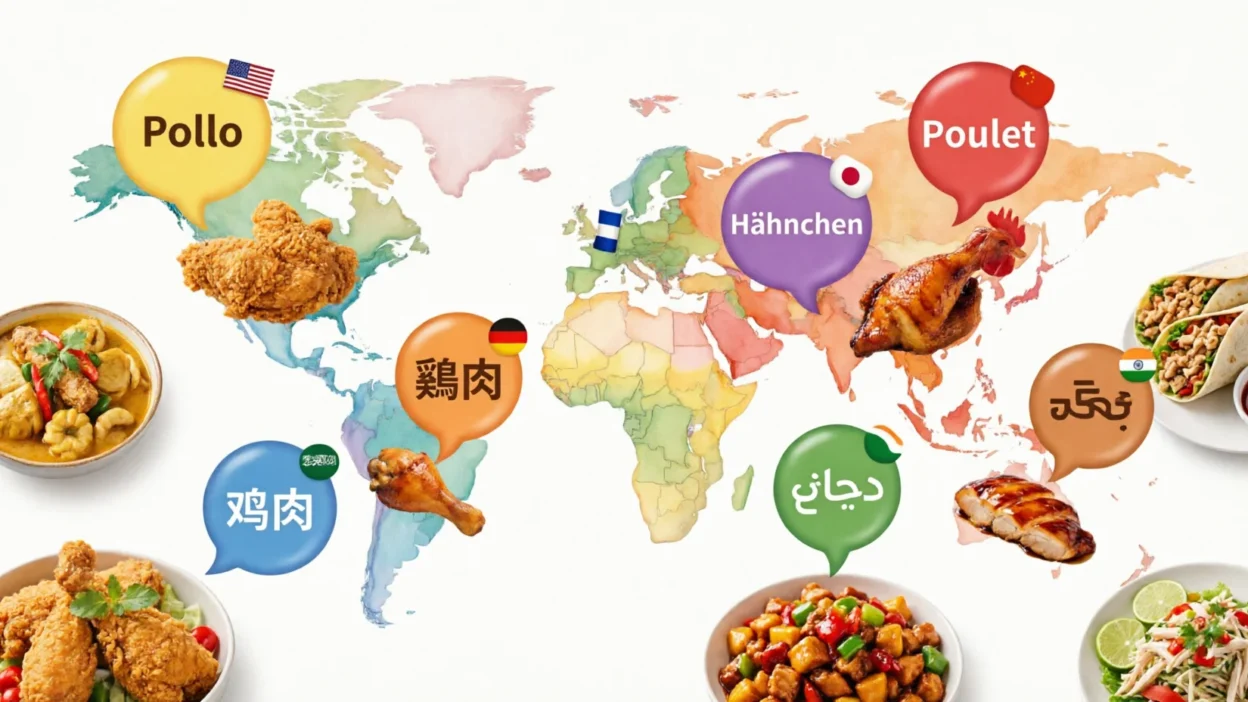
Chicken in different languages is a useful phrase to learn whether you’re traveling, studying a new language, ordering food abroad, or simply expanding your vocabulary.
Since chicken is one of the most commonly eaten foods worldwide, knowing its translation can make communication much easier.
This comprehensive guide includes 70 different languages, along with the native translation, easy English pronunciation, a real-life example sentence, and the English meaning.
If you’re searching for chicken in all languages, how to say chicken in different languages, or chicken translations around the world, you’ll find everything here.
Learning everyday food vocabulary is one of the fastest ways to improve your language skills. Let’s explore how people say “chicken” across the globe.
Chicken in Different Languages (70 Languages)
| # | Language | Native Phrase | Easy Pronunciation | Example Sentence | English Meaning |
|---|---|---|---|---|---|
| 1 | English | Chicken | CHIK-en | I cooked chicken for dinner. | I cooked chicken for dinner. |
| 2 | Spanish | Pollo | POY-yo | Me gusta el pollo. | I like chicken. |
| 3 | French | Poulet | Poo-LAY | J’aime le poulet. | I like chicken. |
| 4 | German | Hähnchen | HEN-chen | Ich esse Hähnchen. | I eat chicken. |
| 5 | Italian | Pollo | POL-lo | Mangio il pollo. | I eat chicken. |
| 6 | Portuguese | Frango | FRAN-goo | Eu gosto de frango. | I like chicken. |
| 7 | Dutch | Kip | Kip | Ik eet kip. | I eat chicken. |
| 8 | Russian | Курица | KOO-ree-tsa | Я люблю курицу. | I like chicken. |
| 9 | Ukrainian | Курка | KOOR-ka | Я їм курку. | I eat chicken. |
| 10 | Polish | Kurczak | KOOR-chak | Lubię kurczaka. | I like chicken. |
| 11 | Czech | Kuře | KOO-rzhe | Jím kuře. | I eat chicken. |
| 12 | Slovak | Kurča | KOOR-cha | Mám rád kurča. | I like chicken. |
| 13 | Hungarian | Csirke | CHEER-keh | Szeretem a csirkét. | I like chicken. |
| 14 | Romanian | Pui | POOY | Îmi place puiul. | I like chicken. |
| 15 | Bulgarian | Пиле | PEE-leh | Обичам пиле. | I like chicken. |
| 16 | Serbian | Пилетина | Pee-leh-TEE-na | Volim piletinu. | I like chicken. |
| 17 | Croatian | Piletina | Pee-leh-TEE-na | Volim piletinu. | I like chicken. |
| 18 | Bosnian | Piletina | Pee-leh-TEE-na | Volim piletinu. | I like chicken. |
| 19 | Slovenian | Piščanec | PISH-cha-nets | Rad jem piščanca. | I like eating chicken. |
| 20 | Greek | Κοτόπουλο | Ko-TO-poo-lo | Μου αρέσει το κοτόπουλο. | I like chicken. |
| 21 | Turkish | Tavuk | Ta-VOOK | Tavuk seviyorum. | I like chicken. |
| 22 | Albanian | Pulë | POO-leh | Më pëlqen pula. | I like chicken. |
| 23 | Lithuanian | Vištiena | VISH-tee-eh-na | Mėgstu vištieną. | I like chicken. |
| 24 | Latvian | Vista | VIS-ta | Man garšo vista. | I like chicken. |
| 25 | Estonian | Kana | KA-na | Mulle meeldib kana. | I like chicken. |
| 26 | Finnish | Kana | KA-na | Pidän kanasta. | I like chicken. |
| 27 | Swedish | Kyckling | SHOOK-ling | Jag gillar kyckling. | I like chicken. |
| 28 | Norwegian | Kylling | SHIL-ling | Jeg liker kylling. | I like chicken. |
| 29 | Danish | Kylling | KUL-ing | Jeg kan lide kylling. | I like chicken. |
| 30 | Icelandic | Kjúklingur | KYOOK-ling-ur | Mér finnst kjúklingur góður. | I like chicken. |
| 31 | Irish | Sicín | Shi-KEEN | Is maith liom sicín. | I like chicken. |
| 32 | Welsh | Cyw Iâr | KUW Yar | Rwy’n hoffi cyw iâr. | I like chicken. |
| 33 | Scottish Gaelic | Cearc | KYARK | Is toil leam cearc. | I like chicken. |
| 34 | Maltese | Tiġieġa | Tee-JAY-ja | Inħobb it-tiġieġa. | I like chicken. |
| 35 | Arabic | دجاج | Da-JAJ | أحب الدجاج. | I like chicken. |
| 36 | Hebrew | עוף | Of | אני אוהב עוף. | I like chicken. |
| 37 | Persian | مرغ | Morgh | من مرغ دوست دارم. | I like chicken. |
| 38 | Urdu | چکن | Chicken | مجھے چکن پسند ہے۔ | I like chicken. |
| 39 | Hindi | चिकन | CHI-kan | मुझे चिकन पसंद है। | I like chicken. |
| 40 | Punjabi | ਚਿਕਨ | CHI-kan | ਮੈਨੂੰ ਚਿਕਨ ਪਸੰਦ ਹੈ। | I like chicken. |
| 41 | Bengali | মুরগি | Mur-gee | আমি মুরগি পছন্দ করি। | I like chicken. |
| 42 | Gujarati | ચિકન | CHI-kan | મને ચિકન ગમે છે. | I like chicken. |
| 43 | Marathi | चिकन | CHI-kan | मला चिकन आवडते. | I like chicken. |
| 44 | Nepali | कुखुरा | KOO-khoo-ra | मलाई कुखुरा मन पर्छ। | I like chicken. |
| 45 | Sinhala | කුකුල් මස් | Koo-kool Mas | මම කුකුල් මස් කැමතියි. | I like chicken. |
| 46 | Tamil | கோழி | KO-zhi | எனக்கு கோழி பிடிக்கும். | I like chicken. |
| 47 | Telugu | కోడి మాంసం | KO-dee Man-sam | నాకు కోడి మాంసం ఇష్టం. | I like chicken. |
| 48 | Kannada | ಕೋಳಿ | KO-li | ನನಗೆ ಕೋಳಿ ಇಷ್ಟ. | I like chicken. |
| 49 | Malayalam | കോഴി | KO-zhi | എനിക്ക് കോഴി ഇഷ്ടമാണ്. | I like chicken. |
| 50 | Odia | କୁକୁଡ଼ା | Koo-koo-da | ମୋତେ କୁକୁଡ଼ା ଭଲ ଲାଗେ। | I like chicken. |
| 51 | Assamese | কুকুৰা | KOO-koo-ra | মই কুকুৰা ভাল পাওঁ। | I like chicken. |
| 52 | Chinese (Simplified) | 鸡肉 | JEE ROH | 我喜欢鸡肉。 | I like chicken. |
| 53 | Japanese | 鶏肉 | Toh-ree NIKU | 鶏肉が好きです。 | I like chicken. |
| 54 | Korean | 닭고기 | Dak-go-gi | 닭고기를 좋아해요. | I like chicken. |
| 55 | Vietnamese | Gà | Gah | Tôi thích gà. | I like chicken. |
| 56 | Thai | ไก่ | Gai | ฉันชอบไก่ | I like chicken. |
| 57 | Indonesian | Ayam | AH-yam | Saya suka ayam. | I like chicken. |
| 58 | Malay | Ayam | AH-yam | Saya suka ayam. | I like chicken. |
| 59 | Filipino | Manok | Ma-NOK | Mahilig ako sa manok. | I like chicken. |
| 60 | Khmer | សាច់មាន់ | Sach Morn | ខ្ញុំចូលចិត្តសាច់មាន់។ | I like chicken. |
| 61 | Lao | ໄກ່ | Gai | ຂ້ອຍມັກໄກ່. | I like chicken. |
| 62 | Burmese | ကြက်သား | Kyet-thar | ကြက်သားကြိုက်တယ်။ | I like chicken. |
| 63 | Mongolian | Тахиа | Ta-khee-ah | Би тахианд дуртай. | I like chicken. |
| 64 | Swahili | Kuku | KOO-koo | Ninapenda kuku. | I like chicken. |
| 65 | Zulu | Inkukhu | In-KOO-koo | Ngithanda inkukhu. | I like chicken. |
| 66 | Afrikaans | Hoender | HOON-der | Ek hou van hoender. | I like chicken. |
| 67 | Yoruba | Adiẹ | Ah-dee-eh | Mo fẹ́ adiẹ. | I like chicken. |
| 68 | Hausa | Kaza | KA-za | Ina son kaza. | I like chicken. |
| 69 | Amharic | ዶሮ | DO-ro | ዶሮ እወዳለሁ። | I like chicken. |
| 70 | Somali | Digaag | Di-GAAG | Waxaan jeclahay digaag. | I like chicken. |
How to Say Chicken in Different Languages
The word chicken has unique translations in every language. Knowing these words is useful when traveling, dining in restaurants, shopping at local markets, or learning a new language.
This collection of chicken translations helps you communicate confidently in many countries.
Why Learn Chicken Translations?
Learning food vocabulary offers many benefits:
- Order meals while traveling.
- Improve your language skills.
- Understand restaurant menus.
- Communicate with native speakers.
- Expand your cultural knowledge.
Chicken Around the World
Chicken is one of the most popular foods worldwide. Every culture prepares it differently, from grilled and roasted dishes to soups, curries, stir-fries, and traditional recipes. Knowing the local word for chicken makes dining abroad much easier.
Tips for Remembering Chicken in Different Languages
- Practice five new words every day.
- Repeat the pronunciation aloud.
- Use each word in a simple sentence.
- Watch cooking videos in different languages.
- Make vocabulary flashcards for review.
Common Situations Where You’ll Use the Word “Chicken”
- Ordering food at restaurants.
- Shopping at grocery stores.
- Reading international recipes.
- Talking about favorite meals.
- Learning everyday vocabulary.
Conclusion
Learning chicken in different languages is a practical way to improve your vocabulary while exploring cultures from around the world. If you’re traveling, studying, or simply curious, these chicken translations will help you communicate more confidently and understand everyday conversations.
FAQs:
1. How do you say chicken in different languages?
Chicken has different names in every language, such as pollo in Spanish, poulet in French, 鸡肉 in Chinese, and 鶏肉 in Japanese.
2. Why should I learn chicken translations?
Learning chicken translations helps when traveling, ordering food, reading menus, and improving your language skills.
3. Is the word for chicken the same as the animal in every language?
Not always. Some languages use one word for the animal and another specifically for chicken meat.
4. Can I use these chicken translations while traveling?
Yes. These translations are useful for restaurants, supermarkets, markets, and conversations with native speakers.
5. Where can I learn more food words in different languages?
You can continue learning everyday food vocabulary such as rice, bread, fish, vegetables, fruits, drinks, and desserts in different languages.

Carter Connor is a language enthusiast and content writer at LingoMean, helping readers discover what to say in everyday conversations with clear explanations, practical examples, and easy-to-understand communication tips.