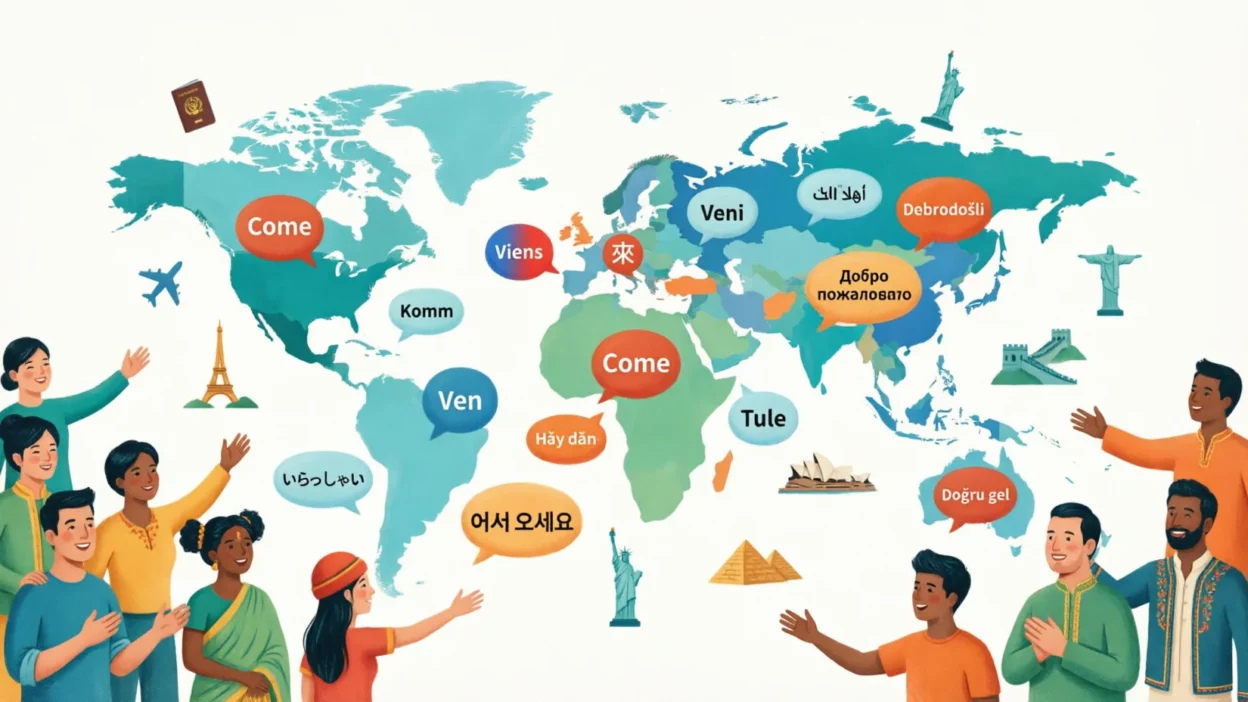
Have you ever wondered how to say come in different languages? If you’re traveling, learning a new language, making international friends, or simply curious about global communication, knowing this simple word can be surprisingly useful.
The word “come” is one of the most common verbs used in everyday conversations. People use it to invite someone, give directions, or ask someone to join them. Learning come translations can make your communication more natural and enjoyable.
In this guide, you’ll discover come in all languages through an easy-to-read table featuring 70 languages, pronunciations, example sentences, and English meanings. You’ll also learn useful facts about using this word correctly in different cultures.
How to Say Come in Different Languages
| # | Language | Native Phrase | Easy Pronunciation | Example Sentence | English Meaning |
|---|---|---|---|---|---|
| 1 | English | Come | Kum | Come here, please. | Come here, please. |
| 2 | Spanish | Ven | Ben | Ven aquí. | Come here. |
| 3 | French | Viens | Vee-ahn | Viens ici. | Come here. |
| 4 | German | Komm | Kom | Komm her. | Come here. |
| 5 | Italian | Vieni | Vee-eh-nee | Vieni qui. | Come here. |
| 6 | Portuguese | Venha | VEN-ya | Venha aqui. | Come here. |
| 7 | Dutch | Kom | Kom | Kom hier. | Come here. |
| 8 | Russian | Иди сюда | Ee-DEE syoo-DA | Иди сюда. | Come here. |
| 9 | Ukrainian | Іди сюди | Ee-DEE syu-DEE | Іди сюди. | Come here. |
| 10 | Polish | Chodź | Hojch | Chodź tutaj. | Come here. |
| 11 | Czech | Pojď | Poyt | Pojď sem. | Come here. |
| 12 | Slovak | Poď | Pod | Poď sem. | Come here. |
| 13 | Hungarian | Gyere | DYEH-reh | Gyere ide. | Come here. |
| 14 | Romanian | Vino | Vee-no | Vino aici. | Come here. |
| 15 | Bulgarian | Ела | Eh-LA | Ела тук. | Come here. |
| 16 | Greek | Έλα | EH-la | Έλα εδώ. | Come here. |
| 17 | Turkish | Gel | Gel | Gel buraya. | Come here. |
| 18 | Arabic | تعال | Ta-aal | تعال هنا. | Come here. |
| 19 | Hebrew | בוא | Bo | בוא הנה. | Come here. |
| 20 | Persian | بیا | Bee-ya | بیا اینجا. | Come here. |
| 21 | Urdu | آؤ | Aao | آؤ یہاں۔ | Come here. |
| 22 | Hindi | आओ | Aao | आओ यहाँ। | Come here. |
| 23 | Punjabi | ਆਓ | Aao | ਆਓ ਇੱਥੇ। | Come here. |
| 24 | Bengali | এসো | Esho | এসো এখানে। | Come here. |
| 25 | Gujarati | આવો | Aavo | આવો અહીં. | Come here. |
| 26 | Marathi | या | Ya | या इथे. | Come here. |
| 27 | Tamil | வா | Vaa | வா இங்கே. | Come here. |
| 28 | Telugu | రా | Raa | రా ఇక్కడికి. | Come here. |
| 29 | Kannada | ಬಾ | Baa | ಬಾ ಇಲ್ಲಿ. | Come here. |
| 30 | Malayalam | വാ | Vaa | വാ ഇവിടെ. | Come here. |
| 31 | Sinhala | එන්න | Enna | එන්න මෙහෙට. | Come here. |
| 32 | Nepali | आऊ | Aau | आऊ यहाँ। | Come here. |
| 33 | Chinese (Mandarin) | 来 | Lai | 来这里。 | Come here. |
| 34 | Japanese | 来て | Ki-te | ここに来て。 | Come here. |
| 35 | Korean | 와 | Wa | 이리 와. | Come here. |
| 36 | Vietnamese | Lại đây | Lai Day | Lại đây. | Come here. |
| 37 | Thai | มา | Ma | มาที่นี่ | Come here. |
| 38 | Indonesian | Datang | Da-tang | Datang ke sini. | Come here. |
| 39 | Malay | Mari | Ma-ree | Mari sini. | Come here. |
| 40 | Filipino | Halika | Ha-lee-ka | Halika rito. | Come here. |
| 41 | Khmer | មក | Mok | មកទីនេះ។ | Come here. |
| 42 | Lao | ມາ | Ma | ມາທີ່ນີ້. | Come here. |
| 43 | Burmese | လာ | La | လာဒီကို။ | Come here. |
| 44 | Mongolian | Ир | Ir | Ир нааш. | Come here. |
| 45 | Swahili | Njoo | N-JOH | Njoo hapa. | Come here. |
| 46 | Zulu | Woza | Wo-za | Woza lapha. | Come here. |
| 47 | Xhosa | Yiza | Yee-za | Yiza apha. | Come here. |
| 48 | Afrikaans | Kom | Kom | Kom hier. | Come here. |
| 49 | Yoruba | Wá | Wa | Wá síbí. | Come here. |
| 50 | Igbo | Bịa | Bee-ah | Bịa ebe a. | Come here. |
| 51 | Hausa | Zo | Zo | Zo nan. | Come here. |
| 52 | Amharic | ና | Na | ና እዚህ. | Come here. |
| 53 | Somali | Kaalay | Kaa-lay | Kaalay halkan. | Come here. |
| 54 | Finnish | Tule | Too-le | Tule tänne. | Come here. |
| 55 | Swedish | Kom | Kom | Kom hit. | Come here. |
| 56 | Norwegian | Kom | Kom | Kom hit. | Come here. |
| 57 | Danish | Kom | Kom | Kom her. | Come here. |
| 58 | Icelandic | Komdu | Kom-du | Komdu hingað. | Come here. |
| 59 | Irish | Tar | Tar | Tar anseo. | Come here. |
| 60 | Welsh | Dere | De-re | Dere yma. | Come here. |
| 61 | Scottish Gaelic | Thig | Hig | Thig an seo. | Come here. |
| 62 | Basque | Etorri | Eh-tor-ree | Etorri hona. | Come here. |
| 63 | Catalan | Vine | VEE-neh | Vine aquí. | Come here. |
| 64 | Galician | Ven | Ben | Ven aquí. | Come here. |
| 65 | Croatian | Dođi | Do-jee | Dođi ovamo. | Come here. |
| 66 | Serbian | Дођи | Do-jee | Дођи овамо. | Come here. |
| 67 | Slovenian | Pridi | Pree-dee | Pridi sem. | Come here. |
| 68 | Albanian | Eja | Eh-ya | Eja këtu. | Come here. |
| 69 | Estonian | Tule | Too-le | Tule siia. | Come here. |
| 70 | Latvian | Nāc | Naats | Nāc šeit. | Come here. |
What Does “Come” Mean?
The word come is used to ask or invite someone to move toward the speaker. It is one of the first action verbs taught in language learning because it appears in everyday conversations.
Examples include:
- Come here.
- Come with me.
- Come inside.
- Come home.
- Come tomorrow.
How to Say Come in Different Languages Correctly
Although the meaning stays the same, each language has its own grammar rules.
For example:
- Some languages change the word depending on formality.
- Others change it based on gender or number.
- Some use different verbs when speaking politely.
Learning these differences helps you sound more natural.
Why Learn Come in All Languages?
There are many reasons to learn come in all languages:
- Improve travel communication.
- Speak with international friends.
- Learn common vocabulary faster.
- Understand movies and TV shows.
- Build confidence while studying languages.
Since “come” is used daily, it’s an excellent word to memorize first.
Common Situations Where You Use the Word “Come”
You’ll hear this word almost everywhere, including:
- Inviting guests
- Calling children
- Giving directions
- Classroom conversations
- Family gatherings
- Workplace discussions
- Shopping
- Traveling
Tips to Remember Come Translations
Learning come translations becomes easier if you:
- Practice five languages each day.
- Repeat each pronunciation aloud.
- Watch native speakers using the word.
- Use flashcards.
- Practice with language exchange partners.
- Create simple sentences using each translation.
Come Around the World
The word come around the world may look different in writing, but its purpose remains nearly identical. Every culture uses this simple verb to invite, welcome, or direct someone toward another person or place.
Learning these translations helps you recognize patterns between languages and makes vocabulary building much easier.
Difference Between “Come” and “Go”
Many beginners confuse these two verbs.
Come
- Movement toward the speaker.
- Example: Come here.
Go
- Movement away from the speaker.
- Example: Go there.
Understanding this difference improves both speaking and writing skills.
Conclusion
Learning come in different languages is a simple yet effective way to improve your communication skills. If you’re traveling, studying languages, or simply exploring cultures, knowing how to say this everyday word helps you connect with people around the world.
Practice these translations regularly, and you’ll quickly become more confident using one of the most common verbs in global conversation.
FAQs:
1. How do you say come in different languages?
The word “come” has unique translations in every language, such as Ven in Spanish, Viens in French, Komm in German, and 来 (Lai) in Chinese.
2. Why should I learn come in different languages?
Learning this common verb improves travel communication, language learning, and everyday conversations with people from different countries.
3. Is the word “come” the same in every language?
No. Every language has its own pronunciation, spelling, and grammar for the word “come.
4. What is the easiest way to memorize come translations?
Practice a few languages every day, speak the words aloud, and use them in short example sentences.
5. Where is the word “come” commonly used?
It is commonly used in invitations, giving directions, welcoming guests, family conversations, schools, workplaces, and daily communication.

Evelyn Grace is a language enthusiast and content writer at LingoMean, where she explains the meaning of words, phrases, and expressions. She creates clear, practical, and engaging content that helps readers confidently understand what to say in everyday conversations.