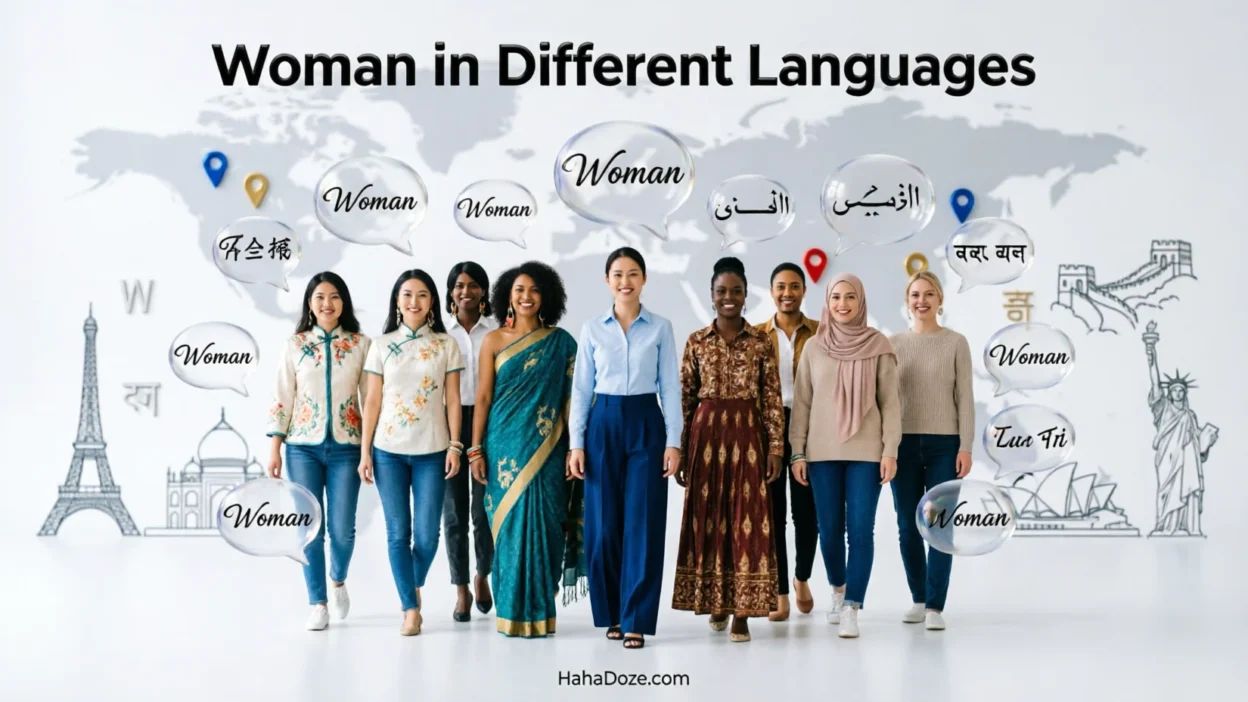
Have you ever wondered how to say woman in different languages? If you’re learning a new language, traveling, studying linguistics, or simply curious about global cultures, knowing the translation of common words like woman can be both useful and fascinating.
This guide includes woman in different languages with correct native spellings, easy English pronunciations, and practical example sentences. You’ll also discover how people refer to a woman across different countries and cultures.
If you’re searching for woman in all languages, how to say woman in different languages, woman translations, or woman around the world, this comprehensive guide has everything you need.
Woman in Different Languages Table
| # | Language | Native Phrase | Pronunciation | Example Sentence | English Meaning |
|---|---|---|---|---|---|
| 1 | English | Woman | WOO-man | The woman is smiling. | The woman is smiling. |
| 2 | Spanish | Mujer | Moo-HEHR | La mujer trabaja aquí. | The woman works here. |
| 3 | French | Femme | Fam | La femme est gentille. | The woman is kind. |
| 4 | German | Frau | Frow | Die Frau liest ein Buch. | The woman is reading a book. |
| 5 | Italian | Donna | DON-na | La donna canta bene. | The woman sings well. |
| 6 | Portuguese | Mulher | Moo-LYER | A mulher chegou cedo. | The woman arrived early. |
| 7 | Dutch | Vrouw | Vrow | De vrouw loopt snel. | The woman walks fast. |
| 8 | Russian | Женщина | ZHEN-shchi-na | Женщина улыбается. | The woman is smiling. |
| 9 | Ukrainian | Жінка | ZHIN-ka | Жінка працює. | The woman is working. |
| 10 | Polish | Kobieta | Ko-BYE-ta | Kobieta czeka. | The woman is waiting. |
| 11 | Czech | Žena | ZHE-na | Žena čte knihu. | The woman reads a book. |
| 12 | Slovak | Žena | ZHE-na | Žena je učiteľka. | The woman is a teacher. |
| 13 | Slovenian | Ženska | ZHEN-ska | Ženska govori. | The woman is speaking. |
| 14 | Croatian | Žena | ZHE-na | Žena kuha. | The woman is cooking. |
| 15 | Serbian | Жена | ZHE-na | Жена пева. | The woman is singing. |
| 16 | Bosnian | Žena | ZHE-na | Žena je ovdje. | The woman is here. |
| 17 | Bulgarian | Жена | ZHE-na | Жената е тук. | The woman is here. |
| 18 | Romanian | Femeie | Fe-MEH-ye | Femeia citește. | The woman is reading. |
| 19 | Greek | Γυναίκα | Yi-NE-ka | Η γυναίκα γελάει. | The woman is laughing. |
| 20 | Turkish | Kadın | Ka-DUN | Kadın geliyor. | The woman is coming. |
| 21 | Arabic | امرأة | Im-ra-ah | المرأة سعيدة. | The woman is happy. |
| 22 | Hebrew | אישה | Ee-SHA | האישה בבית. | The woman is at home. |
| 23 | Persian | زن | Zan | زن مهربان است. | The woman is kind. |
| 24 | Urdu | عورت | Aurat | عورت خوش ہے۔ | The woman is happy. |
| 25 | Hindi | महिला | Ma-hi-LAA | महिला यहाँ है। | The woman is here. |
| 26 | Bengali | মহিলা | Mo-hi-LA | মহিলা হাসছেন। | The woman is smiling. |
| 27 | Punjabi | ਔਰਤ | Au-rat | ਔਰਤ ਆਈ ਹੈ। | The woman has arrived. |
| 28 | Gujarati | સ્ત્રી | Stree | સ્ત્રી હસે છે. | The woman is smiling. |
| 29 | Marathi | महिला | Ma-hi-LAA | महिला आली आहे. | The woman has arrived. |
| 30 | Nepali | महिला | Ma-hi-LAA | महिला यहाँ छिन्। | The woman is here. |
| 31 | Sinhala | කාන්තාව | Kaan-THA-va | කාන්තාව සිනාසෙයි. | The woman smiles. |
| 32 | Tamil | பெண் | Pen | பெண் பேசுகிறாள். | The woman is speaking. |
| 33 | Telugu | మహిళ | Ma-hi-LA | మహిళ నవ్వుతోంది. | The woman is smiling. |
| 34 | Kannada | ಮಹಿಳೆ | Ma-hi-LAY | ಮಹಿಳೆ ಬರುತ್ತಾಳೆ. | The woman is coming. |
| 35 | Malayalam | സ്ത്രീ | Stree | സ്ത്രീ പാടുന്നു. | The woman is singing. |
| 36 | Thai | ผู้หญิง | Poo-YING | ผู้หญิงยิ้ม | The woman smiles. |
| 37 | Vietnamese | Phụ nữ | Foo Noo | Người phụ nữ cười. | The woman is smiling. |
| 38 | Indonesian | Wanita | Wa-NEE-ta | Wanita itu ramah. | The woman is friendly. |
| 39 | Malay | Wanita | Wa-NEE-ta | Wanita itu datang. | The woman arrived. |
| 40 | Filipino | Babae | Ba-ba-E | Ang babae ay mabait. | The woman is kind. |
| 41 | Chinese (Simplified) | 女人 | Nuu-ren | 那个女人很友善。 | That woman is friendly. |
| 42 | Chinese (Traditional) | 女人 | Nuu-ren | 那個女人很好。 | That woman is nice. |
| 43 | Japanese | 女性 | Jo-sei | 女性が歩いています。 | The woman is walking. |
| 44 | Korean | 여자 | Yeo-ja | 여자가 웃어요. | The woman is smiling. |
| 45 | Mongolian | Эмэгтэй | E-meg-tei | Эмэгтэй инээж байна. | The woman is smiling. |
| 46 | Burmese | အမျိုးသမီး | A-myo-tha-mi | အမျိုးသမီးရယ်နေသည်။ | The woman is laughing. |
| 47 | Khmer | ស្ត្រី | Srei | ស្ត្រីញញឹម។ | The woman smiles. |
| 48 | Lao | ແມ່ຍິງ | Mae Ying | ແມ່ຍິງຍິ້ມ. | The woman smiles. |
| 49 | Swahili | Mwanamke | Mwa-nam-ke | Mwanamke anacheka. | The woman is laughing. |
| 50 | Zulu | Owesifazane | O-we-si-fa-ZA-ne | Owesifazane uyahleka. | The woman is laughing. |
| 51 | Xhosa | Umfazi | Um-FA-zi | Umfazi uyacula. | The woman is singing. |
| 52 | Afrikaans | Vrou | Frow | Die vrou glimlag. | The woman smiles. |
| 53 | Yoruba | Obinrin | O-bee-rin | Obinrin naa dun. | The woman is happy. |
| 54 | Igbo | Nwanyị | Nwan-yee | Nwanyị ahụ nọ ebe a. | The woman is here. |
| 55 | Hausa | Mace | MA-che | Mace tana dariya. | The woman is laughing. |
| 56 | Amharic | ሴት | Set | ሴቷ ትስቃለች። | The woman is smiling. |
| 57 | Somali | Haweeney | Ha-WEEN-ey | Haweeneydu way qosleysaa. | The woman is laughing. |
| 58 | Finnish | Nainen | NAI-nen | Nainen hymyilee. | The woman is smiling. |
| 59 | Swedish | Kvinna | KVIN-na | Kvinnan ler. | The woman smiles. |
| 60 | Norwegian | Kvinne | KVIN-ne | Kvinnen leser. | The woman is reading. |
| 61 | Danish | Kvinde | KVIN-de | Kvinden synger. | The woman is singing. |
| 62 | Icelandic | Kona | KO-na | Konan brosir. | The woman smiles. |
| 63 | Estonian | Naine | NAI-ne | Naine töötab. | The woman is working. |
| 64 | Latvian | Sieviete | SEE-vee-e-te | Sieviete smaida. | The woman smiles. |
| 65 | Lithuanian | Moteris | Mo-TE-ris | Moteris dainuoja. | The woman is singing. |
| 66 | Irish | Bean | Ban | Tá an bhean anseo. | The woman is here. |
| 67 | Welsh | Menyw | MEN-yoo | Mae’r fenyw yn hapus. | The woman is happy. |
| 68 | Basque | Emakume | E-ma-KOO-me | Emakumea irribarre egiten du. | The woman is smiling. |
| 69 | Catalan | Dona | DO-na | La dona parla. | The woman is speaking. |
| 70 | Esperanto | Virino | Vi-REE-no | La virino ridetas. | The woman is smiling. |
How to Say Woman in Different Languages
The word woman changes across languages, but it generally refers to an adult female person. Some languages have separate formal and informal words, while others use one standard term in everyday conversation.
Learning these translations helps you:
- Communicate while traveling
- Improve your language skills
- Understand global cultures
- Expand your multilingual vocabulary
- Appreciate linguistic diversity
Woman in All Languages
People around the world use different words for woman, reflecting the uniqueness of their languages and traditions. While pronunciation and spelling vary, the meaning remains the same across cultures.
Knowing woman in all languages is especially useful for students, translators, travelers, and anyone interested in international communication.
Woman Translations Around the World
These woman translations represent languages spoken across Europe, Asia, Africa, the Middle East, and the Americas. Many are among the world’s most widely spoken languages, making them valuable for everyday learning.
By practicing these words regularly, you’ll quickly become familiar with how to identify and pronounce woman around the world.
Tips for Learning Woman in Different Languages
- Learn five new languages each day.
- Practice the pronunciation aloud.
- Write each translation in a notebook.
- Use the word in simple example sentences.
- Review your vocabulary regularly for better retention.
Why Learn Common Words in Multiple Languages?
Simple vocabulary words like woman are among the first words language learners encounter. Mastering them builds confidence and makes it easier to understand conversations, signs, books, and media in other languages.
Conclusion
Learning woman in different languages is an excellent way to expand your vocabulary and gain insight into cultures worldwide.
If you’re learning for travel, education, or personal interest, these 70 translations provide a valuable resource. Keep practicing the words and pronunciations to improve your multilingual communication skills.
FAQs:
1. How do you say woman in different languages?
The word woman has unique translations in every language, such as Mujer in Spanish, Femme in French, Donna in Italian, and Frau in German.
2. Why should I learn woman translations?
Learning common vocabulary helps improve communication, language learning, travel experiences, and cultural understanding.
3. Is the word for woman the same in every language?
No. Every language has its own spelling, pronunciation, and grammar, although the meaning remains the same.
4. Which language uses the word “Donna” for woman?
Italian uses the word Donna to mean woman.
5. Where can I use these woman translations?
You can use them while traveling, studying foreign languages, translating text, communicating internationally, or expanding your vocabulary.
Evelyn Grace is a language enthusiast and content writer at LingoMean, where she explains the meaning of words, phrases, and expressions. She creates clear, practical, and engaging content that helps readers confidently understand what to say in everyday conversations.