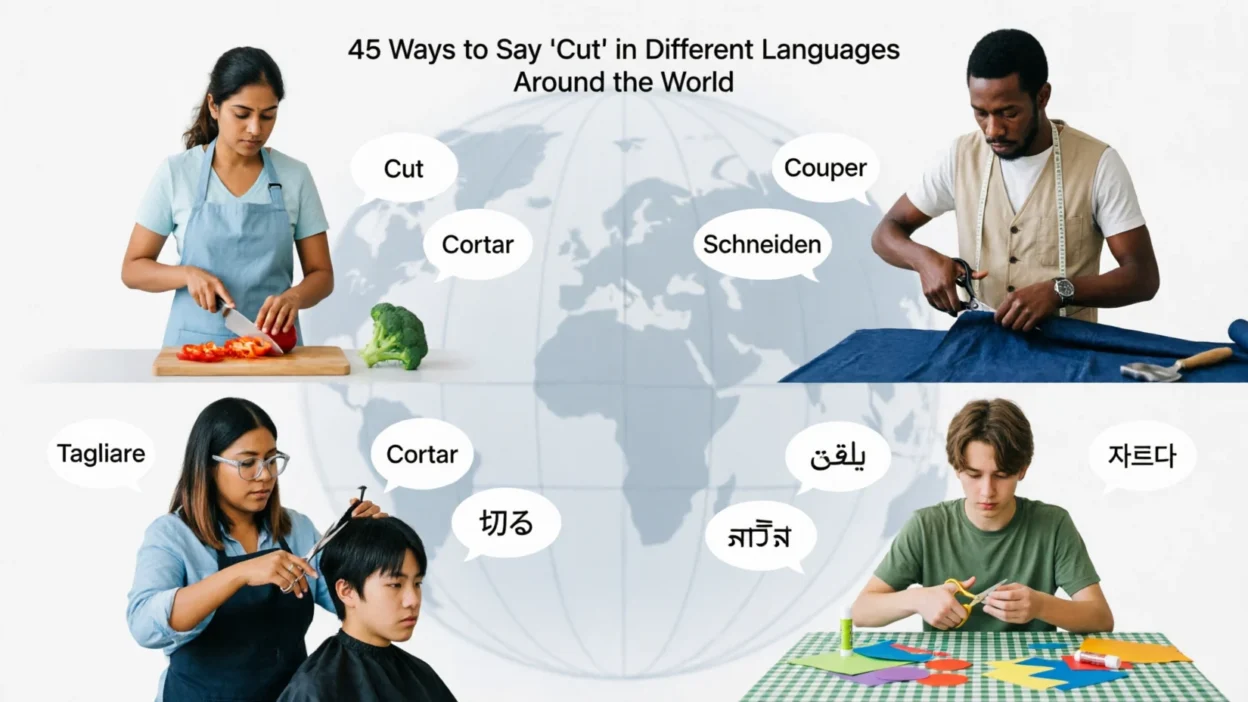
Learning cut in different languages is a practical way to expand your everyday vocabulary and improve communication across different cultures.
The word cut is commonly used in many situations, such as cutting paper, slicing food, trimming hair, editing videos, reducing costs, or making a small wound.
Because it has multiple meanings, learning how to say cut in different languages is useful for travelers, students, chefs, crafters, and language learners.
Many people search for cut in all languages to compare translations and improve their language skills. Learning how to say cut in different languages is helpful for teachers, translators, professionals, and anyone interested in multilingual communication.
These cut translations frequently appear in cooking, arts and crafts, fashion, construction, healthcare, and everyday conversations.
Although the action of cutting is universal, each language has its own word and pronunciation. The table below features cut around the world in 45 popular languages, along with the native translation and an easy English pronunciation.
| Language | Native Phrase | English Pronunciation |
|---|---|---|
| English | Cut | Kut |
| Spanish | Cortar | Kor-TAR |
| French | Couper | Koo-PAY |
| German | Schneiden | SHNY-den |
| Italian | Tagliare | Tal-YA-re |
| Portuguese | Cortar | Kor-TAR |
| Dutch | Snijden | SNY-den |
| Swedish | Skära | SHAIR-a |
| Norwegian | Kutte | KUT-te |
| Danish | Skære | SKAIR-uh |
| Finnish | Leikata | LAY-ka-ta |
| Polish | Ciąć | Chyontch |
| Czech | Řezat | RZHE-zat |
| Slovak | Rezať | RE-zach |
| Hungarian | Vágni | VAAG-nee |
| Romanian | A tăia | Ah Tu-YA |
| Greek | Κόβω | KO-vo |
| Russian | Резать | RYE-zat |
| Ukrainian | Різати | REE-za-ty |
| Turkish | Kesmek | KES-mek |
| Arabic | يقطع | Yak-ta |
| Hebrew | לחתוך | La-kh-TOKH |
| Persian | بریدن | Bo-ree-DAN |
| Hindi | काटना | Kaat-na |
| Urdu | کاٹنا | Kaat-na |
| Bengali | কাটা | Ka-ta |
| Punjabi | ਕੱਟਣਾ | Kat-na |
| Gujarati | કાપવું | Kaa-pa-vu |
| Marathi | कापणे | Kaa-pa-ne |
| Tamil | வெட்ட | Vet-ta |
| Telugu | కోయడం | Koy-a-dam |
| Kannada | ಕತ್ತರಿಸು | Kat-ta-ri-su |
| Malayalam | മുറിക്കുക | Mu-ri-kku-ka |
| Chinese (Mandarin) | 切 | Chye |
| Japanese | 切る | Ki-ru |
| Korean | 자르다 | Ja-reu-da |
| Thai | ตัด | Tat |
| Vietnamese | Cắt | Kat |
| Indonesian | Memotong | Me-mo-TONG |
| Malay | Potong | Po-TONG |
| Filipino | Putulin | Poo-too-lin |
| Swahili | Kata | KA-ta |
| Zulu | Sika | SEE-ka |
| Afrikaans | Sny | Snay |
| Icelandic | Skera | SKE-ra |
What does “cut” mean?
Cut means to divide, trim, slice, or separate something using a sharp tool such as a knife, scissors, or blade. It can also mean to reduce or remove something.
Why should I learn “cut” in different languages?
Learning this word helps you communicate while cooking, shopping, traveling, crafting, working, or discussing everyday tasks in different countries.
Is “cut” used in different contexts?
Yes. Cut can describe slicing food, trimming hair, editing videos, reducing expenses, or making an opening with a sharp object.
Can I use these translations while traveling?
Yes. These translations are useful in restaurants, barber shops, markets, hospitals, craft stores, and many everyday situations.
What is the easiest way to remember “cut” in different languages?
Practice a few translations every day, repeat the pronunciations aloud, and use the words in simple real-life sentences to improve your memory.
Conclusion
Learning cut in different languages is an easy way to improve your everyday vocabulary and communicate more confidently across cultures.
If you’re studying a foreign language, traveling, cooking, or simply expanding your knowledge, these translations will help you express one of the most common actions in daily life.
Bookmark this guide whenever you want to learn cut in all languages, discover cut translations, or explore how to say cut in different languages.

Evelyn Grace is a language enthusiast and content writer at LingoMean, where she explains the meaning of words, phrases, and expressions. She creates clear, practical, and engaging content that helps readers confidently understand what to say in everyday conversations.