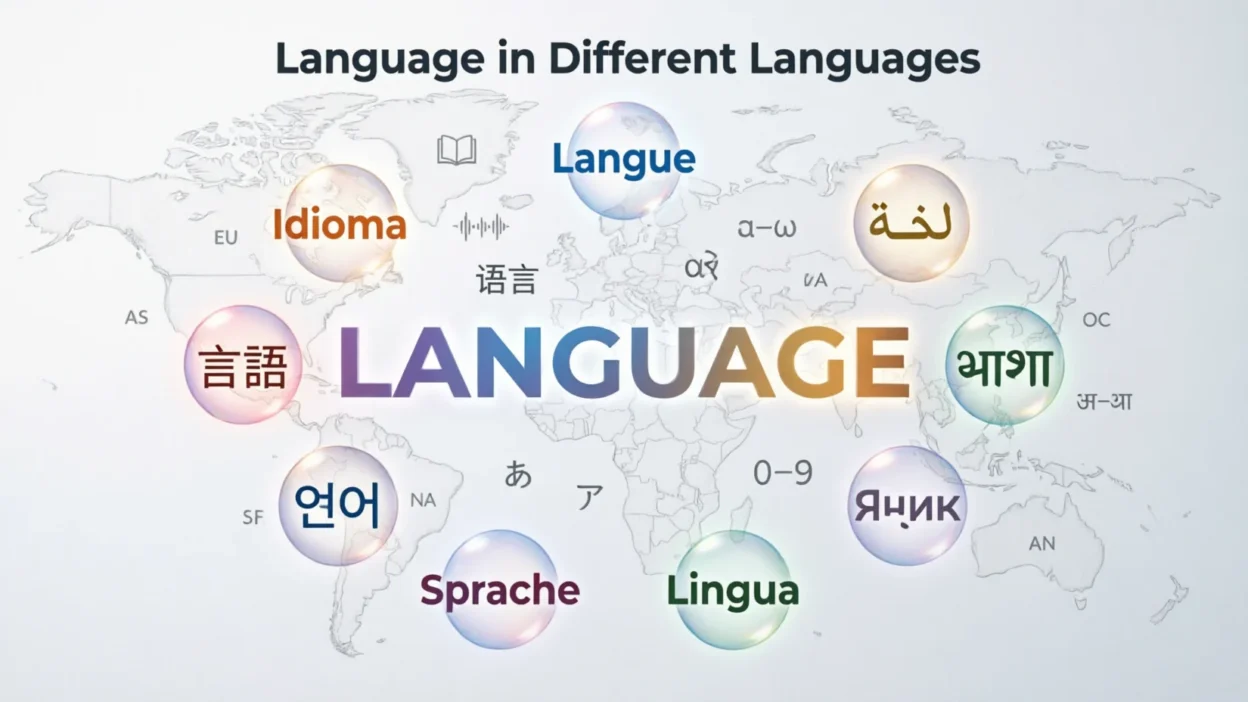
Language is one of the most important ways people communicate, share ideas, express emotions, and preserve culture. If you are learning languages, traveling, studying linguistics, or simply curious about world vocabulary, knowing how to say “language” in different languages can be surprisingly useful.
In this guide, you will discover language in different languages with native translations, easy English pronunciations, and practical example sentences. The table includes exactly 70 languages, making it easy to learn how to say language in different languages and explore useful language translations around the world.
Language in Different Languages: 70 Translations
The word “language” can have slightly different meanings depending on context. In most cases, the translations below refer to a spoken or written human language.
| # | Language | Native Phrase | Easy English Pronunciation | Example Sentence | English Meaning |
|---|---|---|---|---|---|
| 1 | English | language | LANG-gwij | English is a global language. | English is a language used around the world. |
| 2 | Spanish | idioma | ee-DYOH-mah | El español es un idioma hermoso. | Spanish is a beautiful language. |
| 3 | French | langue | lahng | Le français est une langue importante. | French is an important language. |
| 4 | German | Sprache | SHPRAH-khuh | Deutsch ist eine wichtige Sprache. | German is an important language. |
| 5 | Italian | lingua | LEEN-gwah | L’italiano è una bella lingua. | Italian is a beautiful language. |
| 6 | Portuguese | língua | LEEN-gwah | O português é uma língua mundial. | Portuguese is a world language. |
| 7 | Dutch | taal | tahl | Nederlands is een mooie taal. | Dutch is a beautiful language. |
| 8 | Swedish | språk | sprohk | Svenska är ett vackert språk. | Swedish is a beautiful language. |
| 9 | Norwegian | språk | sprohk | Norsk er et viktig språk. | Norwegian is an important language. |
| 10 | Danish | sprog | sproh | Dansk er et interessant sprog. | Danish is an interesting language. |
| 11 | Finnish | kieli | KEE-eh-lee | Suomi on kaunis kieli. | Finnish is a beautiful language. |
| 12 | Icelandic | tungumál | TOONG-oo-maul | Íslenska er fallegt tungumál. | Icelandic is a beautiful language. |
| 13 | Irish | teanga | CHANG-ah | Is teanga álainn í an Ghaeilge. | Irish is a beautiful language. |
| 14 | Welsh | iaith | eye-th | Mae Cymraeg yn iaith hynafol. | Welsh is an ancient language. |
| 15 | Polish | język | YEN-zik | Polski jest trudnym językiem. | Polish is a difficult language. |
| 16 | Czech | jazyk | YAH-zik | Čeština je krásný jazyk. | Czech is a beautiful language. |
| 17 | Slovak | jazyk | YAH-zik | Slovenčina je krásny jazyk. | Slovak is a beautiful language. |
| 18 | Slovenian | jezik | YEH-zik | Slovenščina je lep jezik. | Slovenian is a beautiful language. |
| 19 | Croatian | jezik | YEH-zik | Hrvatski je zanimljiv jezik. | Croatian is an interesting language. |
| 20 | Serbian | језик | YEH-zik | Српски је леп језик. | Serbian is a beautiful language. |
| 21 | Bosnian | jezik | YEH-zik | Bosanski je lijep jezik. | Bosnian is a beautiful language. |
| 22 | Bulgarian | език | eh-ZEEK | Българският е красив език. | Bulgarian is a beautiful language. |
| 23 | Macedonian | јазик | YAH-zik | Македонскиот е убав јазик. | Macedonian is a beautiful language. |
| 24 | Russian | язык | ya-ZEEK | Русский — красивый язык. | Russian is a beautiful language. |
| 25 | Ukrainian | мова | MOH-vah | Українська — красива мова. | Ukrainian is a beautiful language. |
| 26 | Belarusian | мова | MOH-vah | Беларуская — прыгожая мова. | Belarusian is a beautiful language. |
| 27 | Lithuanian | kalba | KAHL-bah | Lietuvių kalba yra graži. | The Lithuanian language is beautiful. |
| 28 | Latvian | valoda | vah-LOH-dah | Latviešu valoda ir skaista. | Latvian is a beautiful language. |
| 29 | Estonian | keel | kayl | Eesti keel on ilus. | Estonian is beautiful. |
| 30 | Greek | γλώσσα | GLOH-sah | Τα ελληνικά είναι όμορφη γλώσσα. | Greek is a beautiful language. |
| 31 | Albanian | gjuhë | GYOO-uh | Shqipja është një gjuhë e bukur. | Albanian is a beautiful language. |
| 32 | Romanian | limbă | LEEM-buh | Româna este o limbă frumoasă. | Romanian is a beautiful language. |
| 33 | Hungarian | nyelv | NYELV | A magyar egy érdekes nyelv. | Hungarian is an interesting language. |
| 34 | Turkish | dil | deel | Türkçe güzel bir dildir. | Turkish is a beautiful language. |
| 35 | Azerbaijani | dil | deel | Azərbaycan dili gözəl dildir. | Azerbaijani is a beautiful language. |
| 36 | Armenian | լեզու | leh-ZOO | Հայերենը գեղեցիկ լեզու է։ | Armenian is a beautiful language. |
| 37 | Georgian | ენა | EH-nah | ქართული ლამაზი ენაა. | Georgian is a beautiful language. |
| 38 | Arabic | لغة | LOO-ghah | العربية لغة جميلة. | Arabic is a beautiful language. |
| 39 | Hebrew | שפה | sah-FAH | עברית היא שפה יפה. | Hebrew is a beautiful language. |
| 40 | Persian | زبان | zah-BAHN | فارسی زبان زیبایی است. | Persian is a beautiful language. |
| 41 | Urdu | زبان | zaa-BAAN | اردو ایک خوبصورت زبان ہے۔ | Urdu is a beautiful language. |
| 42 | Hindi | भाषा | BHAA-shaa | हिंदी एक सुंदर भाषा है। | Hindi is a beautiful language. |
| 43 | Bengali | ভাষা | BHA-sha | বাংলা একটি সুন্দর ভাষা। | Bengali is a beautiful language. |
| 44 | Punjabi | ਭਾਸ਼ਾ | BHA-shaa | ਪੰਜਾਬੀ ਇੱਕ ਸੁੰਦਰ ਭਾਸ਼ਾ ਹੈ। | Punjabi is a beautiful language. |
| 45 | Gujarati | ભાષા | BHAA-shaa | ગુજરાતી એક સુંદર ભાષા છે. | Gujarati is a beautiful language. |
| 46 | Marathi | भाषा | BHAA-shaa | मराठी एक सुंदर भाषा आहे. | Marathi is a beautiful language. |
| 47 | Nepali | भाषा | BHAA-shaa | नेपाली सुन्दर भाषा हो। | Nepali is a beautiful language. |
| 48 | Sinhala | භාෂාව | BHA-shaa-wah | සිංහල ලස්සන භාෂාවක්. | Sinhala is a beautiful language. |
| 49 | Tamil | மொழி | MOH-zhee | தமிழ் ஒரு அழகான மொழி. | Tamil is a beautiful language. |
| 50 | Telugu | భాష | BHA-sha | తెలుగు ఒక అందమైన భాష. | Telugu is a beautiful language. |
| 51 | Kannada | ಭಾಷೆ | BHAA-sheh | ಕನ್ನಡ ಒಂದು ಸುಂದರ ಭಾಷೆ. | Kannada is a beautiful language. |
| 52 | Malayalam | ഭാഷ | BHA-sha | മലയാളം മനോഹരമായ ഭാഷയാണ്. | Malayalam is a beautiful language. |
| 53 | Thai | ภาษา | paa-SĂA | ภาษาไทยเป็นภาษาที่สวยงาม | Thai is a beautiful language. |
| 54 | Vietnamese | ngôn ngữ | ngohn NGU | Tiếng Việt là một ngôn ngữ đẹp. | Vietnamese is a beautiful language. |
| 55 | Indonesian | bahasa | bah-HAH-sah | Bahasa Indonesia adalah bahasa yang indah. | Indonesian is a beautiful language. |
| 56 | Malay | bahasa | bah-HAH-sah | Bahasa Melayu ialah bahasa yang indah. | Malay is a beautiful language. |
| 57 | Filipino | wika | WEE-kah | Ang Filipino ay isang magandang wika. | Filipino is a beautiful language. |
| 58 | Chinese | 语言 | yǔ-YÁN | 中文是一种美丽的语言。 | Chinese is a beautiful language. |
| 59 | Japanese | 言語 | GEN-goh | 日本語は美しい言語です。 | Japanese is a beautiful language. |
| 60 | Korean | 언어 | uh-NUH | 한국어는 아름다운 언어입니다. | Korean is a beautiful language. |
| 61 | Mongolian | хэл | khel | Монгол хэл сайхан хэл. | Mongolian is a beautiful language. |
| 62 | Kazakh | тіл | teel | Қазақ тілі әдемі тіл. | Kazakh is a beautiful language. |
| 63 | Uzbek | til | teel | O‘zbek tili chiroyli til. | Uzbek is a beautiful language. |
| 64 | Swahili | lugha | LOO-ghah | Kiswahili ni lugha nzuri. | Swahili is a beautiful language. |
| 65 | Afrikaans | taal | tahl | Afrikaans is ‘n pragtige taal. | Afrikaans is a beautiful language. |
| 66 | Zulu | ulimi | oo-LEE-mee | IsiZulu ulimi oluhle. | Zulu is a beautiful language. |
| 67 | Xhosa | ulwimi | oo-LWEE-mee | IsiXhosa lulwimi oluhle. | Xhosa is a beautiful language. |
| 68 | Somali | luqad | LOO-qad | Af-Soomaaligu waa luqad qurux badan. | Somali is a beautiful language. |
| 69 | Amharic | ቋንቋ | qwan-QWA | አማርኛ ቆንጆ ቋንቋ ነው። | Amharic is a beautiful language. |
| 70 | Latin | lingua | LEEN-gwah | Lingua Latina antiqua est. | The Latin language is ancient. |
How to Say “Language” in Different Languages
The word “language” changes considerably from one region to another. Some languages use words that sound similar because they share historical roots, while others have completely different vocabulary.
For example, Romance languages often have related forms such as langue, lingua, and língua. Several Slavic languages use words derived from similar roots, including jazyk, jezik, and язык.
Learning these translations is useful for travelers, students, language enthusiasts, writers, and anyone interested in global communication.
Language in All Languages: Interesting Patterns
When exploring language in all languages, you can notice interesting patterns in pronunciation and word formation.
The English word “language” is related to older words associated with speech and the tongue. In many other languages, the word for language is also connected historically with speaking, talking, or the physical tongue.
For instance, several European languages use forms related to Latin lingua, while others developed their own native terms.
Language Translations Around the World
The translations above show how diverse human communication is. From Arabic and Urdu in South Asia and the Middle East to Japanese and Korean in East Asia, every language reflects the history and culture of its speakers.
Some languages are spoken by hundreds of millions of people, while others are used by comparatively smaller communities. Learning even one word from another language can be a useful way to appreciate that diversity.
Why Learn the Word “Language” in Different Languages?
Knowing how to say “language” can be useful in many everyday situations.
If you are traveling, you may need to ask which language someone speaks. Students can use the word when discussing language learning, translation, or linguistics. Writers and content creators can also use these translations when researching international topics.
It is a simple vocabulary word, but it opens the door to learning much more about different cultures.
Tips for Learning Language Translations
Start by learning the native spelling first. Then practice the pronunciation slowly and compare it with recordings from native speakers when available.
You should also learn the word in a complete sentence rather than memorizing it alone. Context makes vocabulary easier to remember and helps you understand how the word is naturally used.
Finally, focus on a few languages at a time. Trying to memorize all 70 translations at once can make learning unnecessarily difficult.
FAQs:
1. What is “language” in different languages?
“Language” has different translations around the world. Examples include idioma in Spanish, langue in French, Sprache in German, lingua in Italian, язык in Russian, لغة in Arabic, and 言語 in Japanese.
2. How do you say “language” in Spanish?
In Spanish, “language” is commonly translated as idioma. It is pronounced approximately “ee-DYOH-mah.” The word lengua can also mean language, especially in certain contexts.
3. What is the word for language in Urdu?
In Urdu, “language” is زبان, pronounced approximately zaa-BAAN. It is a common word used when talking about languages, speech, or linguistic communication.
4. How do you say “language” in French?
In French, “language” is langue, pronounced approximately lahng. It is commonly used when referring to a particular spoken or written language.
5. Why are translations for “language” different around the world?
Languages developed independently or through long periods of historical contact. As a result, each language developed its own vocabulary, pronunciation, and grammatical system. Historical relationships between languages can also explain why some translations look or sound similar.
Conclusion
Learning language in different languages is a simple but interesting way to explore worldwide communication. From idioma in Spanish and langue in French to زبان in Urdu and 言語 in Japanese, the word takes many forms across cultures.
These 70 translations can help students, travelers, writers, and language learners understand how people around the world describe one of the most important parts of human communication.

Brandon Cody is the Administrator of LingoMean, a platform dedicated to helping people discover the right words for every situation. He oversees content quality, website management, and user experience, ensuring readers receive accurate, practical, and easy-to-understand communication guidance.