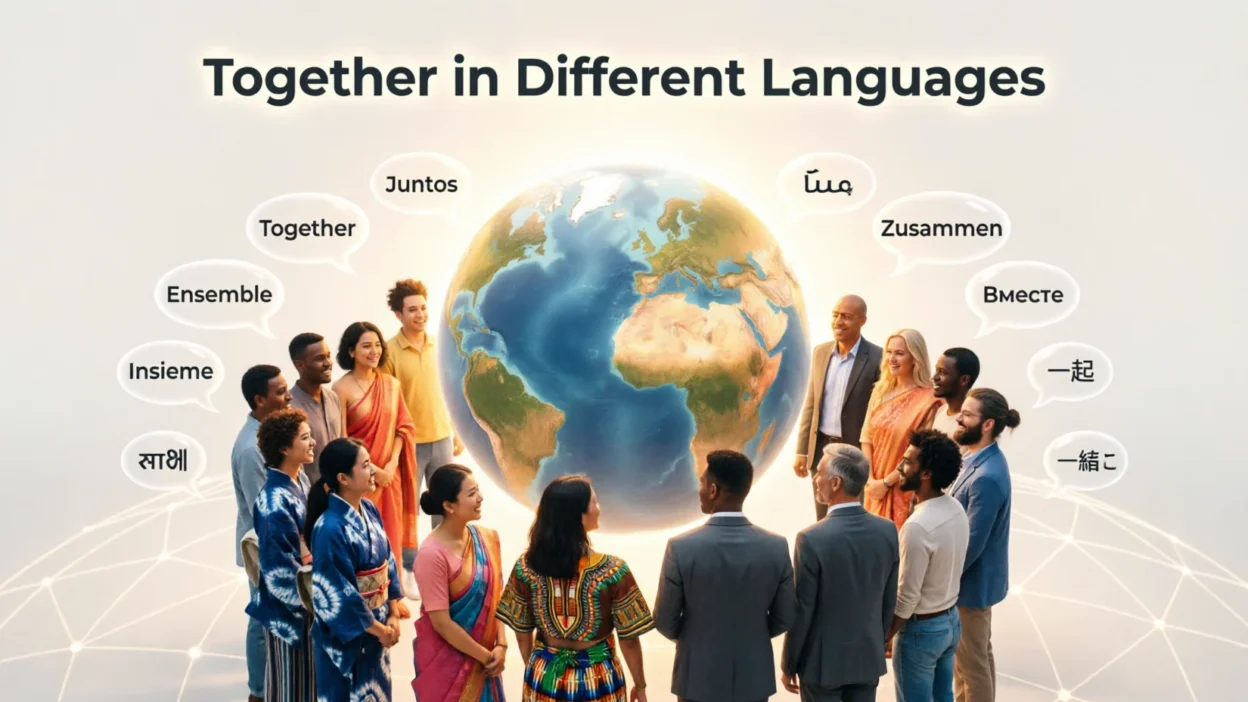
The word “together” expresses unity, closeness, cooperation, and the idea of being with someone or something as a group. If you are learning a new language, traveling, writing a message, or simply exploring world languages, knowing how to say together in different languages can help you communicate more naturally.
The meaning of “together” can vary slightly depending on the context. It may describe people being in the same place, doing something as a group, or staying united. This is why some languages use different expressions depending on the situation.
In this guide, you will find together in all languages represented by 70 widely spoken languages. The table includes the native phrase, an easy English pronunciation, a short real-life example, and the English meaning of each example.
If you are searching for how to say together in different languages, these translations provide a quick and useful reference. You can also use them to explore together translations and understand how the concept of being united is expressed around the world.
Together in Different Languages
| # | Language | Native Phrase | Easy English Pronunciation | Real-Life Example | English Meaning |
|---|---|---|---|---|---|
| 1 | English | Together | tuh-GEH-thur | We work together. | We work as a group. |
| 2 | Spanish | Juntos / Juntas | HOON-tos / HOON-tas | Estamos juntos. | We are together. |
| 3 | French | Ensemble | ahn-SAHM-bluh | Nous sommes ensemble. | We are together. |
| 4 | German | Zusammen | tsoo-ZAH-men | Wir sind zusammen. | We are together. |
| 5 | Italian | Insieme | een-SYEH-meh | Siamo insieme. | We are together. |
| 6 | Portuguese | Juntos / Juntas | ZHOON-toos / ZHOON-tas | Estamos juntos. | We are together. |
| 7 | Dutch | Samen | SAH-men | We zijn samen. | We are together. |
| 8 | Afrikaans | Saam | SAHM | Ons is saam. | We are together. |
| 9 | Swedish | Tillsammans | TIL-sam-mans | Vi är tillsammans. | We are together. |
| 10 | Norwegian | Sammen | SAHM-men | Vi er sammen. | We are together. |
| 11 | Danish | Sammen | SAM-men | Vi er sammen. | We are together. |
| 12 | Finnish | Yhdessä | UHY-dehs-sah | Olemme yhdessä. | We are together. |
| 13 | Icelandic | Saman | SAH-man | Við erum saman. | We are together. |
| 14 | Irish | Le chéile | leh KHYAY-luh | Táimid le chéile. | We are together. |
| 15 | Welsh | Gyda’n gilydd | GUH-dan GIL-ith | Rydyn ni gyda’n gilydd. | We are together. |
| 16 | Scottish Gaelic | Còmhla | KOH-lah | Tha sinn còmhla. | We are together. |
| 17 | Polish | Razem | RAH-zem | Jesteśmy razem. | We are together. |
| 18 | Czech | Spolu | SPOH-loo | Jsme spolu. | We are together. |
| 19 | Slovak | Spolu | SPOH-loo | Sme spolu. | We are together. |
| 20 | Slovenian | Skupaj | skoo-PIE | Smo skupaj. | We are together. |
| 21 | Croatian | Zajedno | zah-YED-noh | Mi smo zajedno. | We are together. |
| 22 | Serbian | Zajedno | zah-YED-noh | Mi smo zajedno. | We are together. |
| 23 | Bosnian | Zajedno | zah-YED-noh | Mi smo zajedno. | We are together. |
| 24 | Macedonian | Заедно | zah-YED-noh | Ние сме заедно. | We are together. |
| 25 | Bulgarian | Заедно | zah-YED-noh | Ние сме заедно. | We are together. |
| 26 | Russian | Вместе | VMYES-teh | Мы вместе. | We are together. |
| 27 | Ukrainian | Разом | RAH-zom | Ми разом. | We are together. |
| 28 | Belarusian | Разам | RAH-zam | Мы разам. | We are together. |
| 29 | Lithuanian | Kartu | KAR-too | Mes kartu. | We are together. |
| 30 | Latvian | Kopā | KOH-pah | Mēs esam kopā. | We are together. |
| 31 | Estonian | Koos | KOHS | Me oleme koos. | We are together. |
| 32 | Hungarian | Együtt | ED-yoot | Együtt vagyunk. | We are together. |
| 33 | Romanian | Împreună | im-preh-OO-nuh | Suntem împreună. | We are together. |
| 34 | Albanian | Bashkë | BASH-kuh | Jemi bashkë. | We are together. |
| 35 | Greek | Μαζί | mah-ZEE | Είμαστε μαζί. | We are together. |
| 36 | Turkish | Birlikte | beer-LEEK-teh | Birlikte çalışıyoruz. | We work together. |
| 37 | Maltese | Flimkien | flim-KEEN | Aħna flimkien. | We are together. |
| 38 | Arabic | معًا | ma-AN | نحن معًا. | We are together. |
| 39 | Hebrew | ביחד | bey-YAH-khad | אנחנו ביחד. | We are together. |
| 40 | Persian | با هم | baa HAM | ما با هم هستیم. | We are together. |
| 41 | Kurdish | Bi hev re | bee hev REH | Em bi hev re ne. | We are together. |
| 42 | Hindi | साथ | SAATH | हम साथ हैं। | We are together. |
| 43 | Urdu | ساتھ | SAATH | ہم ساتھ ہیں۔ | We are together. |
| 44 | Bengali | একসাথে | ek-SHAH-they | আমরা একসাথে আছি। | We are together. |
| 45 | Punjabi | ਇਕੱਠੇ | ik-THAY | ਅਸੀਂ ਇਕੱਠੇ ਹਾਂ। | We are together. |
| 46 | Gujarati | સાથે | SAA-theh | આપણે સાથે છીએ. | We are together. |
| 47 | Marathi | एकत्र | ek-TRAH | आपण एकत्र आहोत. | We are together. |
| 48 | Nepali | सँगै | SANG-gai | हामी सँगै छौं। | We are together. |
| 49 | Sinhala | එකට | EH-ka-ta | අපි එකට ඉන්නවා. | We are together. |
| 50 | Tamil | ஒன்றாக | ON-drah-gah | நாம் ஒன்றாக இருக்கிறோம். | We are together. |
| 51 | Telugu | కలిసి | ka-LI-see | మనం కలిసి ఉన్నాము. | We are together. |
| 52 | Kannada | ಒಟ್ಟಿಗೆ | OT-ti-geh | ನಾವು ಒಟ್ಟಿಗೆ ಇದ್ದೇವೆ. | We are together. |
| 53 | Malayalam | ഒരുമിച്ച് | oh-roo-MICH | നമ്മൾ ഒരുമിച്ചാണ്. | We are together. |
| 54 | Odia | ଏକାଠି | eh-KAA-thi | ଆମେ ଏକାଠି ଅଛୁ। | We are together. |
| 55 | Assamese | একেলগে | eh-keh-LOG-eh | আমি একেলগে আছোঁ। | We are together. |
| 56 | Chinese (Mandarin) | 一起 | YEE-chee | 我们在一起。 | We are together. |
| 57 | Japanese | 一緒に | ee-SHOH-nee | 私たちは一緒にいます。 | We are together. |
| 58 | Korean | 함께 | HAM-keh | 우리는 함께 있어요. | We are together. |
| 59 | Vietnamese | Cùng nhau | KOONG nyow | Chúng ta cùng nhau. | We are together. |
| 60 | Thai | ด้วยกัน | DOO-ay gan | เราอยู่ด้วยกัน | We are together. |
| 61 | Indonesian | Bersama | ber-SAH-mah | Kita bersama. | We are together. |
| 62 | Malay | Bersama | ber-SAH-mah | Kita bersama. | We are together. |
| 63 | Filipino | Magkasama | mag-kah-SAH-mah | Magkasama tayo. | We are together. |
| 64 | Swahili | Pamoja | pah-MOH-jah | Tuko pamoja. | We are together. |
| 65 | Zulu | Ndawonye | ndah-WOHN-yeh | Sikhona ndawonye. | We are together. |
| 66 | Xhosa | Kunye | KOON-yeh | Sikunye. | We are together. |
| 67 | Yoruba | Papọ | pah-PAW | A wà papọ̀. | We are together. |
| 68 | Igbo | Ọnụ | AW-noo | Anyị nọ ọnụ. | We are together. |
| 69 | Amharic | አብረን | AB-ren | አብረን ነን። | We are together. |
| 70 | Haitian Creole | Ansanm | ahn-SAHM | Nou ansanm. | We are together. |
How to Say “Together” in Different Languages
The simplest way to learn how to say together in different languages is to focus on the common expression used when people are physically or emotionally united.
For example, Spanish uses juntos or juntas, French uses ensemble, German uses zusammen, Italian uses insieme, and Portuguese uses juntos or juntas.
In many languages, the translation changes according to grammar, gender, number, or context. Therefore, the word listed in the table is a practical equivalent rather than a universal translation for every possible sentence.
Together in All Languages: Common Uses
“Together” is a flexible English word. It can describe people being in the same place, completing an activity as a group, or maintaining a close relationship.
Here are some common uses:
- We are together. — Describes being with someone.
- Let’s work together. — Describes cooperation.
- They live together. — Describes sharing a home or living arrangement.
- We learned together. — Describes doing an activity as a group.
- They stayed together. — Describes remaining united.
Understanding the context is important when looking at together translations, because some languages may use different grammatical forms depending on the sentence.
Together Around the World
The idea of being together is universal. Different cultures express unity through words that communicate friendship, cooperation, family, partnership, and community.
European languages such as French, German, Italian, Spanish, Polish, and Russian have their own distinct forms. Asian languages such as Hindi, Urdu, Chinese, Japanese, Korean, and Thai also express the concept through culturally natural phrases.
African languages provide another fascinating range of expressions. Words such as pamoja in Swahili and papọ in Yoruba demonstrate how the same basic idea can be expressed differently across regions.
Learning these expressions can be useful for travelers, language students, writers, and anyone interested in international communication.
Why Learn “Together” in Different Languages?
Learning the word “together” in another language can be useful in many everyday situations.
It can help you:
- Communicate while traveling.
- Understand conversations and songs.
- Write meaningful messages.
- Practice vocabulary.
- Connect with people from different cultures.
- Learn how different languages express unity.
Because “together” is frequently used in everyday conversation, learning its equivalent can be a simple way to expand your vocabulary.
Together Translations for Everyday Conversation
If you want to use these words naturally, pay attention to the complete sentence rather than memorizing the word alone.
For example, ensemble in French can appear in sentences describing people being together, while birlikte in Turkish is commonly used when describing doing something together.
Likewise, yhdessä in Finnish, együtt in Hungarian, insieme in Italian, and zusammen in German can all communicate the general idea of being or doing something together.
The surrounding words help determine the most natural translation.
FAQs:
1. How do you say “together” in different languages?
“Together” has different translations around the world. Some common examples are ensemble in French, juntos in Spanish, zusammen in German, insieme in Italian, вместе in Russian, and 一起 in Mandarin Chinese.
2. What is “together” in Spanish?
In Spanish, “together” is commonly juntos for a masculine or mixed group and juntas for a feminine group. For example, Estamos juntos means “We are together.”
3. What is the French word for “together”?
The French word for “together” is ensemble, pronounced approximately “ahn-SAHM-bluh.” For example, Nous sommes ensemble means “We are together.”
4. What is “together” in Hindi and Urdu?
In both Hindi and Urdu, a common word for “together” is साथ / ساتھ, pronounced approximately saath. It is widely used to express being together or accompanying someone.
5. What is the most common meaning of “together”?
The most common meaning of “together” is being with another person or group in the same place or participating in something as a group. It can also describe cooperation, unity, or a close relationship.
Conclusion
Learning how to say together in different languages is a simple and interesting way to explore how cultures express unity and connection. From ensemble in French and insieme in Italian to pamoja in Swahili and 一起 in Mandarin, each language has its own natural way of expressing this universal idea.
The 70 translations above can help with language learning, travel, writing, communication, and cultural exploration. Remember that the exact translation can sometimes change depending on the sentence, grammar, and context.
If you are searching for together in all languages, studying vocabulary, or exploring together around the world, these expressions offer a useful starting point for understanding this common and meaningful word.

Brandon Cody is the Administrator of LingoMean, a platform dedicated to helping people discover the right words for every situation. He oversees content quality, website management, and user experience, ensuring readers receive accurate, practical, and easy-to-understand communication guidance.