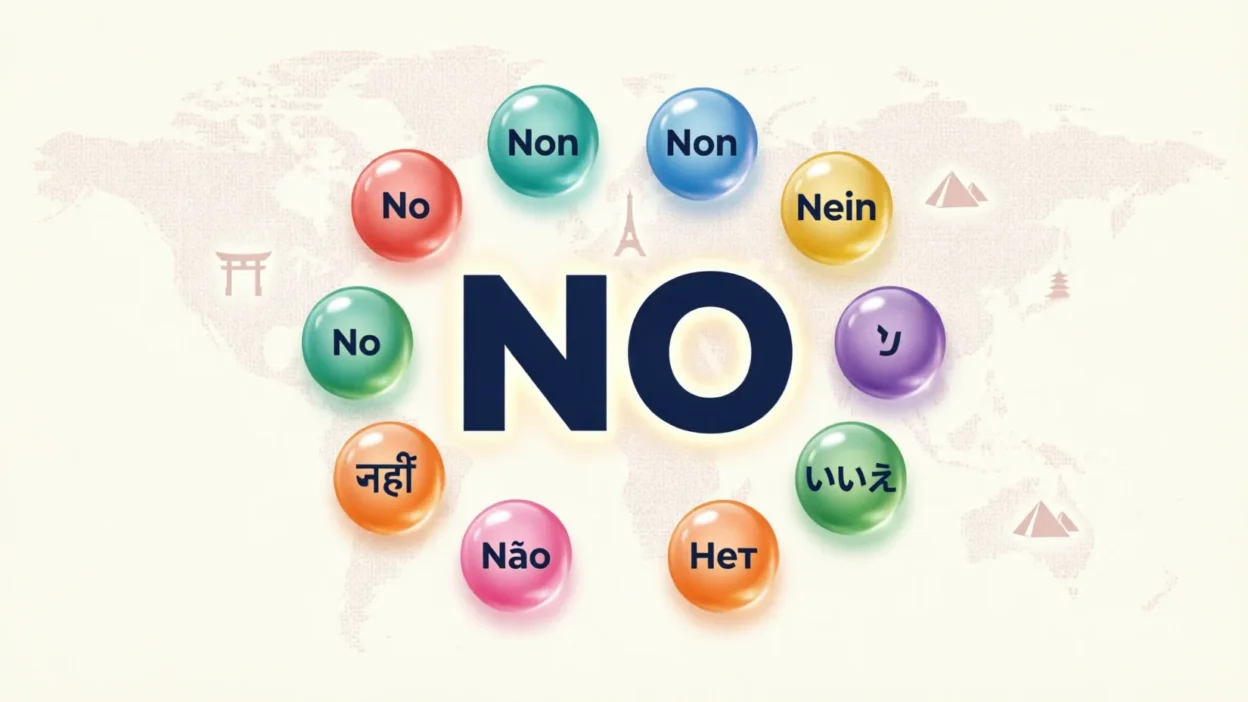
Saying “no” is one of the most useful expressions in any language. If you are traveling, learning a new language, communicating online, or simply exploring how people speak around the world, knowing how to say no in different languages can make everyday communication easier.
The word “no” is usually used to refuse something, disagree with a statement, or politely reject an offer or request. Although the meaning is similar across cultures, the pronunciation and written form can be very different.
In this guide, you will discover no in all languages with simple English pronunciations and short real-life examples. If you are searching for how to say no in different languages, the table below provides 70 common translations in one easy-to-read format.
These no translations also show how a simple two-letter English word changes around the world.
How to Say No in Different Languages
The following table includes 70 languages, their common native word for “no,” an easy pronunciation, and a practical example.
| # | Language | Native Phrase | English Pronunciation | Real-Life Example | English Meaning |
|---|---|---|---|---|---|
| 1 | English | No | Noh | No, thank you. | No, thank you. |
| 2 | Spanish | No | Noh | No, gracias. | No, thank you. |
| 3 | French | Non | Nohn | Non, merci. | No, thank you. |
| 4 | German | Nein | Nine | Nein, danke. | No, thank you. |
| 5 | Italian | No | Noh | No, grazie. | No, thank you. |
| 6 | Portuguese | Não | Nowng | Não, obrigado. | No, thank you. |
| 7 | Dutch | Nee | Nay | Nee, dank je. | No, thank you. |
| 8 | Swedish | Nej | Nay | Nej, tack. | No, thank you. |
| 9 | Norwegian | Nei | Nye | Nei, takk. | No, thank you. |
| 10 | Danish | Nej | Nye | Nej, tak. | No, thank you. |
| 11 | Finnish | Ei | Ay | Ei, kiitos. | No, thank you. |
| 12 | Icelandic | Nei | Nay | Nei, takk. | No, thank you. |
| 13 | Irish | Níl | Neel | Níl, go raibh maith agat. | No, thank you. |
| 14 | Welsh | Na | Nah | Na, diolch. | No, thank you. |
| 15 | Scottish Gaelic | Chan eil | Khan yel | Chan eil, tapadh leat. | No, thank you. |
| 16 | Polish | Nie | Nyeh | Nie, dziękuję. | No, thank you. |
| 17 | Czech | Ne | Neh | Ne, děkuji. | No, thank you. |
| 18 | Slovak | Nie | Nyeh | Nie, ďakujem. | No, thank you. |
| 19 | Slovenian | Ne | Neh | Ne, hvala. | No, thank you. |
| 20 | Croatian | Ne | Neh | Ne, hvala. | No, thank you. |
| 21 | Serbian | Ne | Neh | Ne, hvala. | No, thank you. |
| 22 | Bosnian | Ne | Neh | Ne, hvala. | No, thank you. |
| 23 | Bulgarian | Не | Neh | Не, благодаря. | No, thank you. |
| 24 | Macedonian | Не | Neh | Не, благодарам. | No, thank you. |
| 25 | Russian | Нет | Nyet | Нет, спасибо. | No, thank you. |
| 26 | Ukrainian | Ні | Nee | Ні, дякую. | No, thank you. |
| 27 | Belarusian | Не | Nyeh | Не, дзякуй. | No, thank you. |
| 28 | Lithuanian | Ne | Neh | Ne, ačiū. | No, thank you. |
| 29 | Latvian | Nē | Nay | Nē, paldies. | No, thank you. |
| 30 | Estonian | Ei | Ay | Ei, aitäh. | No, thank you. |
| 31 | Romanian | Nu | Noo | Nu, mulțumesc. | No, thank you. |
| 32 | Hungarian | Nem | Nemm | Nem, köszönöm. | No, thank you. |
| 33 | Greek | Όχι | O-khee | Όχι, ευχαριστώ. | No, thank you. |
| 34 | Albanian | Jo | Yoh | Jo, faleminderit. | No, thank you. |
| 35 | Armenian | Ոչ | Voch | Ոչ, շնորհակալություն. | No, thank you. |
| 36 | Georgian | არა | Ah-rah | არა, მადლობა. | No, thank you. |
| 37 | Turkish | Hayır | Hi-yuhr | Hayır, teşekkürler. | No, thank you. |
| 38 | Azerbaijani | Xeyr | Khair | Xeyr, təşəkkür edirəm. | No, thank you. |
| 39 | Persian | نه | Na | نه، ممنون. | No, thanks. |
| 40 | Arabic | لا | Laa | لا، شكرًا. | No, thank you. |
| 41 | Hebrew | לא | Loh | לא, תודה. | No, thank you. |
| 42 | Hindi | नहीं | Nahin | नहीं, धन्यवाद। | No, thank you. |
| 43 | Urdu | نہیں | Nahin | نہیں، شکریہ۔ | No, thank you. |
| 44 | Bengali | না | Na | না, ধন্যবাদ। | No, thank you. |
| 45 | Punjabi | ਨਹੀਂ | Nahin | ਨਹੀਂ, ਧੰਨਵਾਦ। | No, thank you. |
| 46 | Gujarati | ના | Naa | ના, આભાર. | No, thank you. |
| 47 | Marathi | नाही | Naa-hee | नाही, धन्यवाद. | No, thank you. |
| 48 | Nepali | होइन | Ho-y-na | होइन, धन्यवाद। | No, thank you. |
| 49 | Sinhala | නැහැ | Na-hae | නැහැ, ස්තුතියි. | No, thank you. |
| 50 | Tamil | இல்லை | Il-lai | இல்லை, நன்றி. | No, thank you. |
| 51 | Telugu | కాదు | Kaa-doo | కాదు, ధన్యవాదాలు. | No, thank you. |
| 52 | Kannada | ಇಲ್ಲ | Il-la | ಇಲ್ಲ, ಧನ್ಯವಾದಗಳು. | No, thank you. |
| 53 | Malayalam | ഇല്ല | Il-la | ഇല്ല, നന്ദി. | No, thank you. |
| 54 | Odia | ନା | Naa | ନା, ଧନ୍ୟବାଦ। | No, thank you. |
| 55 | Assamese | নাই | Nai | নাই, ধন্যবাদ। | No, thank you. |
| 56 | Chinese (Mandarin) | 不 / 不是 | Boo / Boo shrr | 不,谢谢。 | No, thank you. |
| 57 | Japanese | いいえ | Ee-eh | いいえ、ありがとう。 | No, thank you. |
| 58 | Korean | 아니요 | Ah-nee-yo | 아니요, 감사합니다. | No, thank you. |
| 59 | Vietnamese | Không | Khong | Không, cảm ơn. | No, thank you. |
| 60 | Thai | ไม่ | Mai | ไม่ ขอบคุณ | No, thank you. |
| 61 | Indonesian | Tidak | Tee-dahk | Tidak, terima kasih. | No, thank you. |
| 62 | Malay | Tidak | Tee-dahk | Tidak, terima kasih. | No, thank you. |
| 63 | Filipino | Hindi | Hin-dee | Hindi, salamat. | No, thank you. |
| 64 | Javanese | Ora | Oh-rah | Ora, matur nuwun. | No, thank you. |
| 65 | Swahili | Hapana | Ha-pa-na | Hapana, asante. | No, thank you. |
| 66 | Zulu | Cha | Chah | Cha, ngiyabonga. | No, thank you. |
| 67 | Afrikaans | Nee | Nee | Nee, dankie. | No, thank you. |
| 68 | Amharic | አይ | Eye | አይ፣ አመሰግናለሁ። | No, thank you. |
| 69 | Somali | Maya | Ma-ya | Maya, mahadsanid. | No, thank you. |
| 70 | Malagasy | Tsia | Tsee-ah | Tsia, misaotra. | No, thank you. |
No in All Languages: What Does It Mean?
The basic purpose of “no” is similar in most languages. It can express refusal, disagreement, rejection, or a negative answer.
For example, you might say “no” when someone asks whether you want coffee, when you disagree with an idea, or when you want to refuse an invitation.
However, some languages use different forms depending on the situation. In Mandarin Chinese, for example, the appropriate negative word can change according to the sentence and meaning.
This is why learning the simple translation is useful, but understanding the context is even more important.
No Translations Around the World
The word “no” has many interesting forms across different language families.
Romance languages often have short forms such as no in Spanish and Italian, non in French, and não in Portuguese. Germanic languages include forms such as nein, nee, and nej.
Slavic languages commonly use forms such as nie, ne, нет, and ні. Across South Asia, you can find forms including nahi, na, and related expressions.
In East and Southeast Asia, words such as Japanese いいえ, Korean 아니요, Vietnamese không, and Thai ไม่ demonstrate the wide variety of ways to express the same basic idea.
How to Say No Politely in Different Languages
Simply knowing the word for “no” is not always enough. Tone and politeness can be important when speaking another language.
Adding a word meaning “thank you” can make a refusal sound more polite. For example:
- Spanish: No, gracias.
- French: Non, merci.
- German: Nein, danke.
- Italian: No, grazie.
- Japanese: いいえ、ありがとう。
- Korean: 아니요, 감사합니다.
- Arabic: لا، شكرًا.
When traveling, learning a polite version can be more useful than memorizing the word “no” by itself.
Why Learn No in Different Languages?
Learning how to say no in different languages is useful for travelers, students, language learners, and anyone interested in world languages.
It can help you:
- Communicate basic responses while traveling.
- Understand conversations in other languages.
- Recognize negative answers in international content.
- Learn useful everyday vocabulary.
- Communicate more naturally with people from different cultures.
A single word can also be a simple starting point for exploring a completely new language.
Common Uses of the Word “No”
“No” can be used in several everyday situations.
Refusing an Offer
Someone may offer you food or a drink, and you can politely decline.
Example: “No, thank you.”
Disagreeing
You can use “no” when you believe a statement is incorrect.
Example: “No, that is not correct.”
Answering a Question
“No” can provide a direct negative answer.
Example: “Are you ready?” — “No.”
Setting a Boundary
“No” can also communicate that you do not want to do something.
Example: “No, I don’t want to go.”
The exact expression and level of politeness can vary depending on the language and culture.
Conclusion
Learning no in different languages is a simple and practical way to expand your vocabulary. From Spanish no and French non to Japanese いいえ, Arabic لا, Hindi नहीं, and Swahili hapana, the same basic idea appears in many different forms around the world.
Knowing these no translations can help you communicate during travel, understand international conversations, and build confidence when learning a new language. Remember that pronunciation, context, and politeness can vary, so use the examples as a helpful starting point.
If you want to know how to say no in different languages for travel, study, or curiosity, this list gives you 70 useful expressions to explore.
FAQs:
1. How do you say “no” in different languages?
“No” can be expressed in many ways, including no in Spanish and Italian, non in French, nein in German, niet in Dutch, нет in Russian, لا in Arabic, and いいえ in Japanese.
2. What is “no” in the most common languages?
Common translations include no in Spanish, non in French, nein in German, não in Portuguese, нет in Russian, não in Portuguese, لا in Arabic, नहीं in Hindi, and 不 or related negative forms in Mandarin Chinese.
3. How do you say no politely in another language?
A common way to make “no” more polite is to add “thank you.” For example, Spanish uses No, gracias, French uses Non, merci, and German uses Nein, danke.
4. What language uses “nein” for no?
Nein is the standard word for “no” in German. It is pronounced approximately like “nine” in English.
5. Why are there different words for no around the world?
Languages developed independently within different cultures and language families. As a result, the same basic concept can have completely different words, pronunciations, and grammatical forms.

Evelyn Grace is a language enthusiast and content writer at LingoMean, where she explains the meaning of words, phrases, and expressions. She creates clear, practical, and engaging content that helps readers confidently understand what to say in everyday conversations.