Saying “thank you” is one of the simplest ways to show kindness, respect, and appreciation. Although the words change from one language to another, the meaning remains universal.
Learning how to say thank you in different languages can help you communicate more warmly when traveling, meeting international friends, studying languages, or connecting with people from different cultures.
This guide covers thank you in all languages through 70 widely spoken and culturally important languages. Each translation includes the correct native phrase, an easy English pronunciation, a short real-life example, and the English meaning of that example.
If you are searching for how to say thank you in different languages, this list makes it easy to find the phrase you need. From European languages to Asian, African, Middle Eastern, and Indigenous languages, these thank you translations show how gratitude is expressed around the world.
Thank You in Different Languages: 70 Translations
The table below provides thank you in different languages in a simple format. Pronunciations are written approximately for English speakers and may vary slightly by region or accent.
| # | Language | Native Phrase | Easy English Pronunciation | Real-Life Example | English Meaning |
|---|---|---|---|---|---|
| 1 | English | Thank you | Thank yoo | Thank you for your help. | I appreciate your help. |
| 2 | Spanish | Gracias | GRAH-see-ahs | Gracias por venir. | Thank you for coming. |
| 3 | French | Merci | mehr-SEE | Merci pour votre aide. | Thank you for your help. |
| 4 | German | Danke | DAHN-kuh | Danke für deine Hilfe. | Thank you for your help. |
| 5 | Italian | Grazie | GRAHT-see-eh | Grazie per tutto. | Thank you for everything. |
| 6 | Portuguese | Obrigado / Obrigada | oh-bree-GAH-doo / oh-bree-GAH-dah | Obrigado pela ajuda. | Thank you for the help. |
| 7 | Dutch | Dank je | DAHNK yuh | Dank je voor alles. | Thank you for everything. |
| 8 | Afrikaans | Dankie | DAHN-kee | Dankie vir jou hulp. | Thank you for your help. |
| 9 | Swedish | Tack | TAHK | Tack för hjälpen. | Thank you for the help. |
| 10 | Norwegian | Takk | TAHK | Takk for maten. | Thank you for the meal. |
| 11 | Danish | Tak | TAHK | Tak for din hjælp. | Thank you for your help. |
| 12 | Finnish | Kiitos | KEE-tos | Kiitos avustasi. | Thank you for your help. |
| 13 | Icelandic | Takk | TAHK | Takk fyrir hjálpina. | Thank you for the help. |
| 14 | Irish | Go raibh maith agat | guh rev mah AH-gut | Go raibh maith agat as cabhrú liom. | Thank you for helping me. |
| 15 | Scottish Gaelic | Tapadh leat | TAH-puh let | Tapadh leat airson do chuideachaidh. | Thank you for your help. |
| 16 | Welsh | Diolch | DEE-olkh | Diolch am eich help. | Thank you for your help. |
| 17 | Polish | Dziękuję | jen-KOO-yeh | Dziękuję za pomoc. | Thank you for the help. |
| 18 | Czech | Děkuji | DYEH-koo-yee | Děkuji za pomoc. | Thank you for the help. |
| 19 | Slovak | Ďakujem | JAH-koo-yem | Ďakujem za pomoc. | Thank you for the help. |
| 20 | Slovenian | Hvala | HVAH-lah | Hvala za pomoč. | Thank you for the help. |
| 21 | Croatian | Hvala | HVAH-lah | Hvala na pomoći. | Thank you for the help. |
| 22 | Serbian | Hvala | HVAH-lah | Hvala na pomoći. | Thank you for the help. |
| 23 | Bosnian | Hvala | HVAH-lah | Hvala na pomoći. | Thank you for the help. |
| 24 | Macedonian | Благодарам | blah-goh-DAH-rahm | Благодарам за помошта. | Thank you for the help. |
| 25 | Bulgarian | Благодаря | blah-goh-dah-RYAH | Благодаря за помощта. | Thank you for the help. |
| 26 | Russian | Спасибо | spah-SEE-bah | Спасибо за помощь. | Thank you for the help. |
| 27 | Ukrainian | Дякую | DYA-koo-yoo | Дякую за допомогу. | Thank you for the help. |
| 28 | Belarusian | Дзякуй | DZYAH-kooy | Дзякуй за дапамогу. | Thank you for the help. |
| 29 | Lithuanian | Ačiū | ah-CHOO | Ačiū už pagalbą. | Thank you for the help. |
| 30 | Latvian | Paldies | PAHL-dee-ehs | Paldies par palīdzību. | Thank you for the help. |
| 31 | Estonian | Aitäh | EYE-tah | Aitäh abi eest. | Thank you for the help. |
| 32 | Hungarian | Köszönöm | KUR-suh-nurm | Köszönöm a segítséget. | Thank you for the help. |
| 33 | Romanian | Mulțumesc | mool-tsoo-MESK | Mulțumesc pentru ajutor. | Thank you for the help. |
| 34 | Greek | Ευχαριστώ | ef-khah-ree-STOH | Ευχαριστώ για τη βοήθεια. | Thank you for the help. |
| 35 | Albanian | Faleminderit | fah-leh-min-DEH-reet | Faleminderit për ndihmën. | Thank you for the help. |
| 36 | Turkish | Teşekkür ederim | teh-sheh-KOOR eh-deh-REEM | Yardımınız için teşekkür ederim. | Thank you for your help. |
| 37 | Azerbaijani | Təşəkkür edirəm | teh-sheh-KOOR eh-dee-REM | Köməyiniz üçün təşəkkür edirəm. | Thank you for your help. |
| 38 | Armenian | Շնորհակալություն | shnor-ha-ka-loo-TYOON | Շնորհակալություն օգնության համար։ | Thank you for the help. |
| 39 | Georgian | გმადლობთ | gma-DLOBT | გმადლობთ დახმარებისთვის. | Thank you for the help. |
| 40 | Arabic | شكراً | SHOOK-ran | شكراً على مساعدتك. | Thank you for your help. |
| 41 | Hebrew | תודה | toh-DAH | תודה על העזרה. | Thank you for the help. |
| 42 | Persian | ممنون | mam-NOON | ممنون از کمکتان. | Thank you for your help. |
| 43 | Urdu | شکریہ | SHUK-ree-ah | آپ کی مدد کا شکریہ۔ | Thank you for your help. |
| 44 | Hindi | धन्यवाद | dhan-ya-VAAD | आपकी मदद के लिए धन्यवाद। | Thank you for your help. |
| 45 | Bengali | ধন্যবাদ | DHON-no-baad | আপনার সাহায্যের জন্য ধন্যবাদ। | Thank you for your help. |
| 46 | Punjabi | ਧੰਨਵਾਦ | dhan-na-VAAD | ਤੁਹਾਡੀ ਮਦਦ ਲਈ ਧੰਨਵਾਦ। | Thank you for your help. |
| 47 | Gujarati | આભાર | AA-bhaar | તમારી મદદ માટે આભાર. | Thank you for your help. |
| 48 | Marathi | धन्यवाद | dhan-ya-VAAD | तुमच्या मदतीबद्दल धन्यवाद. | Thank you for your help. |
| 49 | Nepali | धन्यवाद | dhan-ya-BAAD | तपाईंको सहयोगको लागि धन्यवाद। | Thank you for your help. |
| 50 | Sinhala | ස්තුතියි | stoo-tee-YEE | ඔබගේ උදව්වට ස්තුතියි. | Thank you for your help. |
| 51 | Tamil | நன்றி | NAN-dree | உங்கள் உதவிக்கு நன்றி. | Thank you for your help. |
| 52 | Telugu | ధన్యవాదాలు | dhan-ya-VA-da-lu | మీ సహాయానికి ధన్యవాదాలు. | Thank you for your help. |
| 53 | Kannada | ಧನ್ಯವಾದಗಳು | dhan-ya-VA-da-ga-lu | ನಿಮ್ಮ ಸಹಾಯಕ್ಕೆ ಧನ್ಯವಾದಗಳು. | Thank you for your help. |
| 54 | Malayalam | നന്ദി | NAN-dee | നിങ്ങളുടെ സഹായത്തിന് നന്ദി. | Thank you for your help. |
| 55 | Thai | ขอบคุณ | khop-KHOON | ขอบคุณสำหรับความช่วยเหลือ. | Thank you for your help. |
| 56 | Lao | ຂອບໃຈ | khawp-JAI | ຂອບໃຈສຳລັບຄວາມຊ່ວຍເຫຼືອ. | Thank you for your help. |
| 57 | Khmer | អរគុណ | aw-KOON | អរគុណសម្រាប់ជំនួយរបស់អ្នក។ | Thank you for your help. |
| 58 | Vietnamese | Cảm ơn | gahm UHN | Cảm ơn bạn đã giúp tôi. | Thank you for helping me. |
| 59 | Indonesian | Terima kasih | tuh-REE-mah KAH-see | Terima kasih atas bantuanmu. | Thank you for your help. |
| 60 | Malay | Terima kasih | tuh-REE-mah KAH-seeh | Terima kasih atas bantuan anda. | Thank you for your help. |
| 61 | Filipino | Salamat | sah-LAH-maht | Salamat sa tulong mo. | Thank you for your help. |
| 62 | Chinese (Mandarin) | 谢谢 | SHYEH-shyeh | 谢谢你的帮助。 | Thank you for your help. |
| 63 | Japanese | ありがとう | ah-ree-GAH-toh | 手伝ってくれてありがとう。 | Thank you for helping me. |
| 64 | Korean | 감사합니다 | gam-SAHM-nee-da | 도와주셔서 감사합니다. | Thank you for helping me. |
| 65 | Mongolian | Баярлалаа | bah-YAR-lah-LAH | Тусалсанд баярлалаа. | Thank you for helping me. |
| 66 | Swahili | Asante | ah-SAHN-teh | Asante kwa msaada wako. | Thank you for your help. |
| 67 | Somali | Mahadsanid | mahad-SAH-nid | Mahadsanid caawimadaada. | Thank you for your help. |
| 68 | Zulu | Ngiyabonga | ngee-yah-BONG-ah | Ngiyabonga ngosizo lwakho. | Thank you for your help. |
| 69 | Xhosa | Enkosi | en-KOH-see | Enkosi ngoncedo lwakho. | Thank you for your help. |
| 70 | Malagasy | Misaotra | mee-SOW-trah | Misaotra tamin’ny fanampianao. | Thank you for your help. |
How to Say Thank You in Different Languages
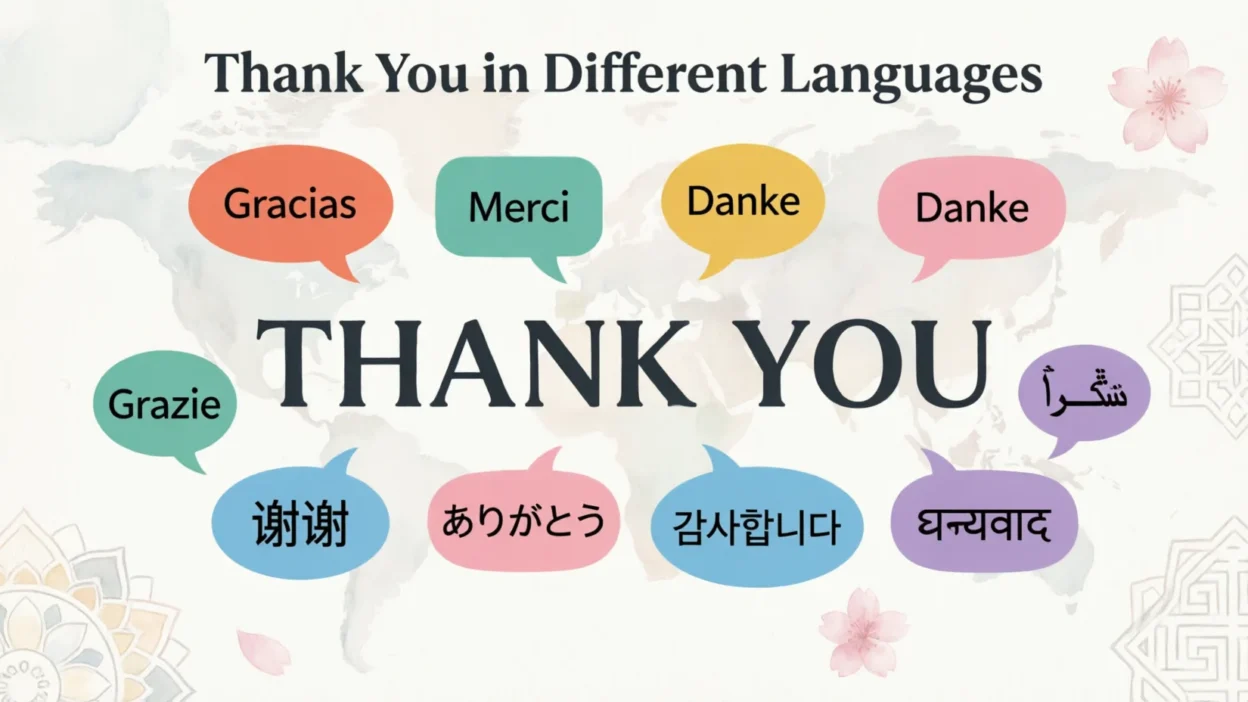
The easiest way to learn thank you in different languages is to begin with the most commonly used everyday forms. Words such as gracias, merci, danke, grazie, arigatou, xie xie, and shukriya are useful starting points.
Pronunciation is also important. A phrase may look simple in writing but sound different when spoken by a native speaker. The pronunciation column above gives an easy approximation for English speakers.
When speaking with native speakers, listening to the local pronunciation and copying the rhythm can help you sound more natural.
Thank You in All Languages: Understanding Cultural Differences
The phrase “thank you” is universal, but the way gratitude is expressed can vary significantly between cultures.
Some languages have different forms depending on gender, formality, social status, or the relationship between speakers. For example, Portuguese uses obrigado when spoken by a male and obrigada when spoken by a female.
In other languages, a single common expression works in most everyday situations. Context still matters, especially when speaking with elders, professionals, or people you have just met.
Learning these small cultural details can make your communication more respectful and meaningful.
Formal and Informal Thank You Translations
Not every situation requires the same level of formality.
When speaking with close friends or family members, a short and casual form may be perfectly natural. In professional situations, however, a more respectful expression is often preferred.
For example, Turkish speakers commonly use teşekkür ederim as a polite way to say thank you. In English, simply saying “thanks” can sound casual, while “thank you very much” can sound more formal.
Before using a translation, consider who you are speaking to and the situation in which you are using it.
Why Learn Thank You Around the World?
Learning how people say thank you around the world can be useful for travelers, students, language learners, teachers, and anyone interested in international cultures.
A simple thank-you phrase can make interactions more pleasant. Using someone’s native language, even for just one word, often shows that you have made an effort to communicate respectfully.
These expressions can also be useful when writing greeting cards, creating international content, communicating with friends, or preparing for a trip.
Tips for Using Thank You in Different Languages
Learn the pronunciation first: Knowing how to pronounce the phrase makes your communication more natural.
Understand the context: Some expressions are more formal than others.
Use the native script when possible: Seeing the original spelling can help you recognize the phrase when reading.
Practice short sentences: Instead of memorizing only one word, practice phrases such as “Thank you for your help” or “Thank you for coming.”
Respect regional differences: A language can have different expressions or pronunciation styles depending on the country or region.
FAQs:
1. What is “thank you” in the most common languages?
Some widely recognized translations include gracias in Spanish, merci in French, danke in German, grazie in Italian, obrigado/obrigada in Portuguese, arigatou in Japanese, xie xie in Mandarin Chinese, and shukriya in Urdu.
2. How do you say “thank you” in 70 languages?
“Thank you” can be expressed in many different ways, including gracias, merci, danke, grazie, takk, hvala, спасибо, дякую, شكراً, धन्यवाद, நன்றி, ขอบคุณ, salamat, asante, ngiyabonga, and many others. The complete list of 70 languages is provided in the table above.
3. What is the easiest language in which to say thank you?
There is no single easiest language for everyone. Short expressions such as tack in Swedish, tak in Danish, hvala in several South Slavic languages, and merci in French are relatively simple for English speakers to pronounce.
4. Is “thank you” the same in every language?
No. Every language has its own word or expression for gratitude. Some languages also change the expression according to formality, gender, relationship, or context.
5. Why should I learn how to say thank you in different languages?
Learning thank-you phrases can help you communicate respectfully with people from different cultures. It is especially useful when traveling, studying languages, meeting international friends, or communicating in multicultural environments.
Conclusion
Learning thank you in different languages is a simple way to explore the world’s languages and cultures. From merci in French and gracias in Spanish to arigatou in Japanese and asante in Swahili, every expression carries the same basic message of appreciation.
Knowing these thank you translations can make conversations more welcoming and help you connect with people around the world. Whether you are preparing for travel, learning a new language, or simply curious about international communication, practicing these expressions is a useful and enjoyable place to start.

Anthony Dylan is a language enthusiast and content writer at LingoMean, where he helps readers understand what to say in different situations. He creates clear, practical, and engaging guides that improve communication, confidence, and everyday conversations.