Saying “yes” is one of the simplest ways to show agreement, acceptance, or understanding. But when you travel, learn a new language, or communicate with people from different cultures, knowing how to say yes in different languages can make conversations easier and more welcoming.
The word “yes” has many forms around the world. Some languages use a short and familiar sound, while others have words with completely different pronunciation and spelling. Learning these expressions can also help you understand movies, songs, conversations, travel phrases, and everyday communication.
If you are searching for yes in all languages, this guide provides 70 useful translations in one easy-to-read table. Each entry includes the native phrase, a simple English pronunciation, and a short real-life example.
If you want to know how to say yes in different languages, compare yes translations, or discover how people say “yes” around the world, the list below gives you a practical starting point.
Yes in Different Languages: 70 Translations
The table below shows common ways to say “yes” in 70 languages. Pronunciations are written in a simple English-friendly form to make them easier to read and practice.
| # | Language | Native Phrase | Easy English Pronunciation | Short Real-Life Example | English Meaning |
|---|---|---|---|---|---|
| 1 | English | Yes | Yes | Yes, I agree. | Yes, I agree. |
| 2 | Spanish | Sí | See | Sí, quiero ir. | Yes, I want to go. |
| 3 | French | Oui | Wee | Oui, bien sûr. | Yes, of course. |
| 4 | German | Ja | Yah | Ja, ich komme. | Yes, I am coming. |
| 5 | Italian | Sì | See | Sì, va bene. | Yes, that’s fine. |
| 6 | Portuguese | Sim | Seem | Sim, eu quero. | Yes, I want it. |
| 7 | Dutch | Ja | Yah | Ja, graag. | Yes, gladly. |
| 8 | Swedish | Ja | Yah | Ja, det gör jag. | Yes, I do. |
| 9 | Norwegian | Ja | Yah | Ja, det kan jeg. | Yes, I can. |
| 10 | Danish | Ja | Yah | Ja, tak. | Yes, please. |
| 11 | Finnish | Kyllä | KULL-lah | Kyllä, kiitos. | Yes, thank you. |
| 12 | Icelandic | Já | Yow | Já, takk. | Yes, thank you. |
| 13 | Irish | Tá | Taw | Tá, cinnte. | Yes, certainly. |
| 14 | Welsh | Ie | Yeh | Ie, wrth gwrs. | Yes, of course. |
| 15 | Scottish Gaelic | Tha | Ha | Tha, gu dearbh. | Yes, indeed. |
| 16 | Catalan | Sí | See | Sí, d’acord. | Yes, okay. |
| 17 | Romanian | Da | Dah | Da, sigur. | Yes, sure. |
| 18 | Albanian | Po | Poh | Po, patjetër. | Yes, definitely. |
| 19 | Greek | Ναι | Neh | Ναι, φυσικά. | Yes, of course. |
| 20 | Bulgarian | Да | Dah | Да, разбира се. | Yes, of course. |
| 21 | Serbian | Да | Dah | Да, хвала. | Yes, thank you. |
| 22 | Croatian | Da | Dah | Da, hvala. | Yes, thank you. |
| 23 | Slovenian | Da | Dah | Da, seveda. | Yes, of course. |
| 24 | Slovak | Áno | AH-no | Áno, ďakujem. | Yes, thank you. |
| 25 | Czech | Ano | AH-no | Ano, jistě. | Yes, certainly. |
| 26 | Polish | Tak | Tahk | Tak, oczywiście. | Yes, of course. |
| 27 | Ukrainian | Так | Tahk | Так, звичайно. | Yes, of course. |
| 28 | Russian | Да | Dah | Да, конечно. | Yes, of course. |
| 29 | Belarusian | Так | Tahk | Так, дзякуй. | Yes, thank you. |
| 30 | Lithuanian | Taip | Tipe | Taip, žinoma. | Yes, of course. |
| 31 | Latvian | Jā | Yah | Jā, protams. | Yes, of course. |
| 32 | Estonian | Jah | Yah | Jah, muidugi. | Yes, of course. |
| 33 | Hungarian | Igen | EE-gen | Igen, persze. | Yes, of course. |
| 34 | Turkish | Evet | Eh-vet | Evet, tabii. | Yes, of course. |
| 35 | Azerbaijani | Bəli | Beh-lee | Bəli, əlbəttə. | Yes, certainly. |
| 36 | Armenian | Այո | Eye-oh | Այո, իհարկե։ | Yes, of course. |
| 37 | Georgian | დიახ | Dee-akh | დიახ, რა თქმა უნდა. | Yes, of course. |
| 38 | Persian | بله | Bah-leh | بله، حتماً. | Yes, definitely. |
| 39 | Arabic | نعم | Na-am | نعم، بالتأكيد. | Yes, certainly. |
| 40 | Hebrew | כן | Ken | כן, בטח. | Yes, sure. |
| 41 | Hindi | हाँ | Haan | हाँ, बिल्कुल। | Yes, absolutely. |
| 42 | Urdu | ہاں | Haan | ہاں، بالکل۔ | Yes, absolutely. |
| 43 | Bengali | হ্যাঁ | Hyan | হ্যাঁ, অবশ্যই। | Yes, certainly. |
| 44 | Punjabi | ਹਾਂ | Haan | ਹਾਂ, ਜ਼ਰੂਰ। | Yes, certainly. |
| 45 | Gujarati | હા | Haa | હા, ચોક્કસ. | Yes, definitely. |
| 46 | Marathi | हो | Ho | हो, नक्की. | Yes, definitely. |
| 47 | Nepali | हो | Ho | हो, पक्कै। | Yes, definitely. |
| 48 | Sinhala | ඔව් | Ow | ඔව්, අනිවාර්යයෙන්ම. | Yes, definitely. |
| 49 | Tamil | ஆம் | Aam | ஆம், நிச்சயமாக. | Yes, certainly. |
| 50 | Telugu | అవును | Ah-voo-noo | అవును, తప్పకుండా. | Yes, definitely. |
| 51 | Kannada | ಹೌದು | How-doo | ಹೌದು, ಖಂಡಿತ. | Yes, definitely. |
| 52 | Malayalam | അതെ | Ah-theh | അതെ, തീർച്ചയായും. | Yes, certainly. |
| 53 | Chinese (Mandarin) | 是 | Shì | 是的,我同意。 | Yes, I agree. |
| 54 | Japanese | はい | Hai | はい、わかりました。 | Yes, I understand. |
| 55 | Korean | 네 | Neh | 네, 알겠습니다. | Yes, I understand. |
| 56 | Vietnamese | Có | Kaw | Có, tôi đồng ý. | Yes, I agree. |
| 57 | Thai | ใช่ | Chai | ใช่, แน่นอน | Yes, certainly. |
| 58 | Indonesian | Ya | Yah | Ya, saya setuju. | Yes, I agree. |
| 59 | Malay | Ya | Yah | Ya, saya faham. | Yes, I understand. |
| 60 | Filipino | Oo | Oh-oh | Oo, gusto ko. | Yes, I want it. |
| 61 | Mongolian | Тийм | Teem | Тийм, баярлалаа. | Yes, thank you. |
| 62 | Swahili | Ndiyo | N-dee-yo | Ndiyo, asante. | Yes, thank you. |
| 63 | Zulu | Yebo | Yeh-boh | Yebo, ngiyavuma. | Yes, I agree. |
| 64 | Afrikaans | Ja | Yah | Ja, dankie. | Yes, thank you. |
| 65 | Amharic | አዎ | Ah-woh | አዎ፣ እሺ። | Yes, okay. |
| 66 | Somali | Haa | Haa | Haa, waan fahmay. | Yes, I understand. |
| 67 | Yoruba | Bẹ́ẹ̀ni | Beh-eh-nee | Bẹ́ẹ̀ni, mo fẹ́. | Yes, I want it. |
| 68 | Hausa | Eh | Eh | Eh, na yarda. | Yes, I agree. |
| 69 | Malayalam | അതെ | Ah-theh | അതെ, ശരിയാണ്. | Yes, that is correct. |
| 70 | Esperanto | Jes | Yes | Jes, mi konsentas. | Yes, I agree. |
How to Say “Yes” in Different Languages
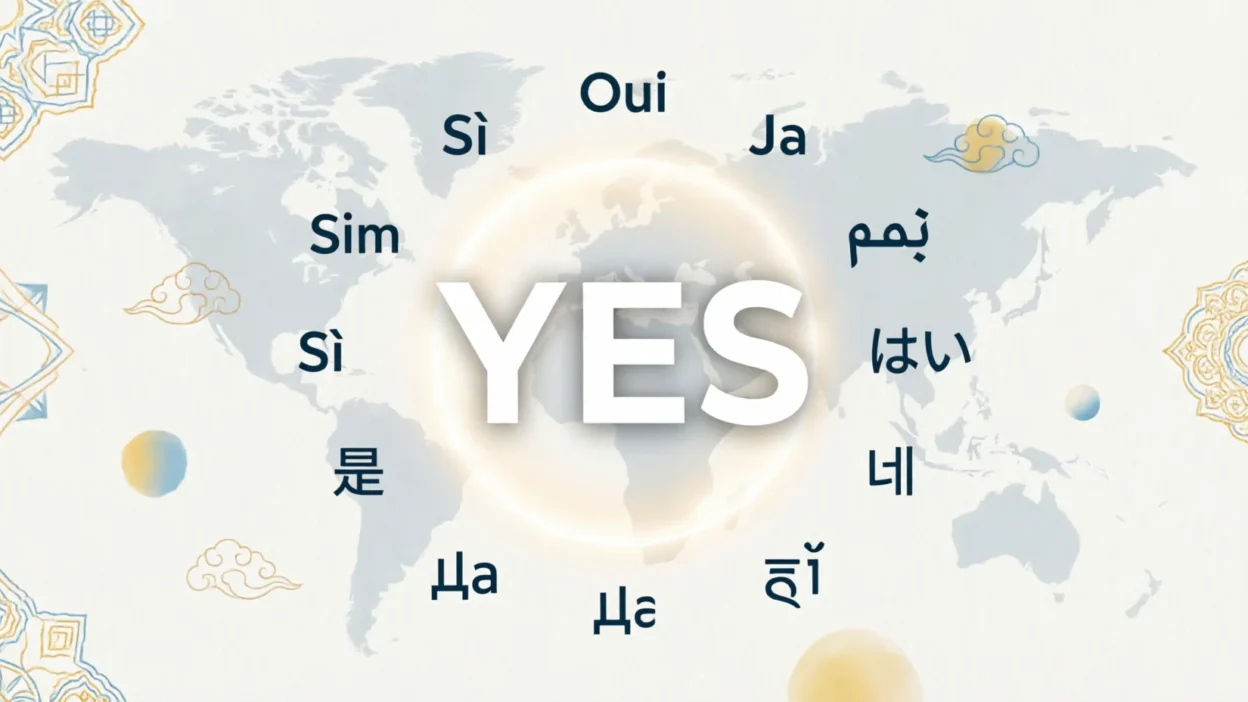
The most common translations of “yes” are often short and easy to remember. For example, Spanish uses sí, French uses oui, German uses ja, Italian uses sì, and Portuguese uses sim.
In many languages, the word changes slightly depending on pronunciation, formality, or the context of the conversation. A simple “yes” may be enough for casual communication, while longer expressions can sound more polite or enthusiastic.
Yes in All Languages: Common Patterns
Looking at yes in all languages reveals some interesting similarities. Several European languages use forms such as “ja,” “da,” or “sí.” Scandinavian languages commonly use “ja,” while several Slavic languages use “da” or related forms.
Asian languages have more varied expressions. Japanese commonly uses “hai,” Korean uses “ne,” Hindi and Urdu use “haan,” and Mandarin Chinese commonly uses “shi” in affirmative statements.
African languages also have their own distinct forms. Swahili uses “ndiyo,” Zulu uses “yebo,” Somali uses “haa,” and Amharic uses “awo.”
Yes Translations for Travel and Everyday Conversation
Learning a few yes translations can be useful when traveling. Even a single local word can make basic conversations more comfortable.
You can use these expressions when answering questions, accepting invitations, confirming information, or showing agreement. Pronunciation does not have to be perfect. Making a genuine effort to use a local word can still make communication feel more natural.
For example, saying “oui” in France, “sí” in Spain, “ja” in Germany, or “hai” in Japan can be a simple way to practice the local language.
Yes Around the World
The word “yes” appears in almost every language, but its sound and written form can vary dramatically. Exploring yes around the world shows how different languages express the same basic idea of agreement.
Some words are especially similar across neighboring languages because they share historical roots. Others developed independently and sound completely different.
This makes “yes” an interesting word for language learners because it is short, practical, and frequently used in everyday conversations.
Why Learn “Yes” in Different Languages?
Learning how to say “yes” can be useful for several reasons:
- It is one of the most frequently needed conversational words.
- It can help travelers communicate basic agreement.
- It provides an easy first phrase for language learners.
- It can make conversations with international friends more engaging.
- It helps you recognize affirmative responses in foreign-language media.
- It gives you a quick introduction to another language and culture.
Conclusion
Learning yes in different languages is a simple way to explore the diversity of human communication. From “sí” in Spanish and “oui” in French to “hai” in Japanese and “ndiyo” in Swahili, each language has its own way of expressing agreement.
The 70 translations above can help travelers, students, writers, and language enthusiasts discover how this useful word is spoken around the world. If you are looking for yes in all languages, practicing yes translations, or simply wondering how to say yes in different languages, these examples provide an easy reference for everyday use.
FAQs:
1. What is “yes” in different languages?
“Yes” has different forms across languages. Common examples include “sí” in Spanish, “oui” in French, “ja” in German, “da” in Russian, “hai” in Japanese, and “ne” in Korean.
2. How do you say yes in Spanish?
In Spanish, “yes” is sí, pronounced approximately “see.” For example, “Sí, quiero” means “Yes, I want to.”
3. How do you say yes in French?
In French, “yes” is oui, pronounced approximately “wee.” A common phrase is “Oui, bien sûr,” meaning “Yes, of course.”
4. How do you say yes in Japanese?
In Japanese, “yes” is commonly はい (hai), pronounced “high.” It is frequently used to show agreement, acceptance, or acknowledgment.
5. What are some easy ways to say yes in other languages?
Some easy examples are sí in Spanish, oui in French, ja in German, sim in Portuguese, ya in Indonesian and Malay, haan in Hindi and Urdu, and yes/jes in English and Esperanto.
Meta Description:
Discover how to say yes in different languages with 70 translations, easy pronunciations, and real-life examples from languages around the world.

Carter Connor is a language enthusiast and content writer at LingoMean, helping readers discover what to say in everyday conversations with clear explanations, practical examples, and easy-to-understand communication tips.