Saying goodbye is a simple part of everyday communication, but the words people use to part ways can sound very different from one language to another.
Learning how to say goodbye in different languages is a useful way to understand cultures, communicate with international friends, and make conversations feel more natural.
If you are traveling, learning a new language, writing to someone from another country, or simply curious about world languages, this guide makes it easy to discover goodbye in all languages.
Below, you will find 70 common goodbye translations with their native phrases, easy English pronunciations, and short examples. These expressions show how people say farewell in different parts of the world and give you a practical look at goodbye around the world.
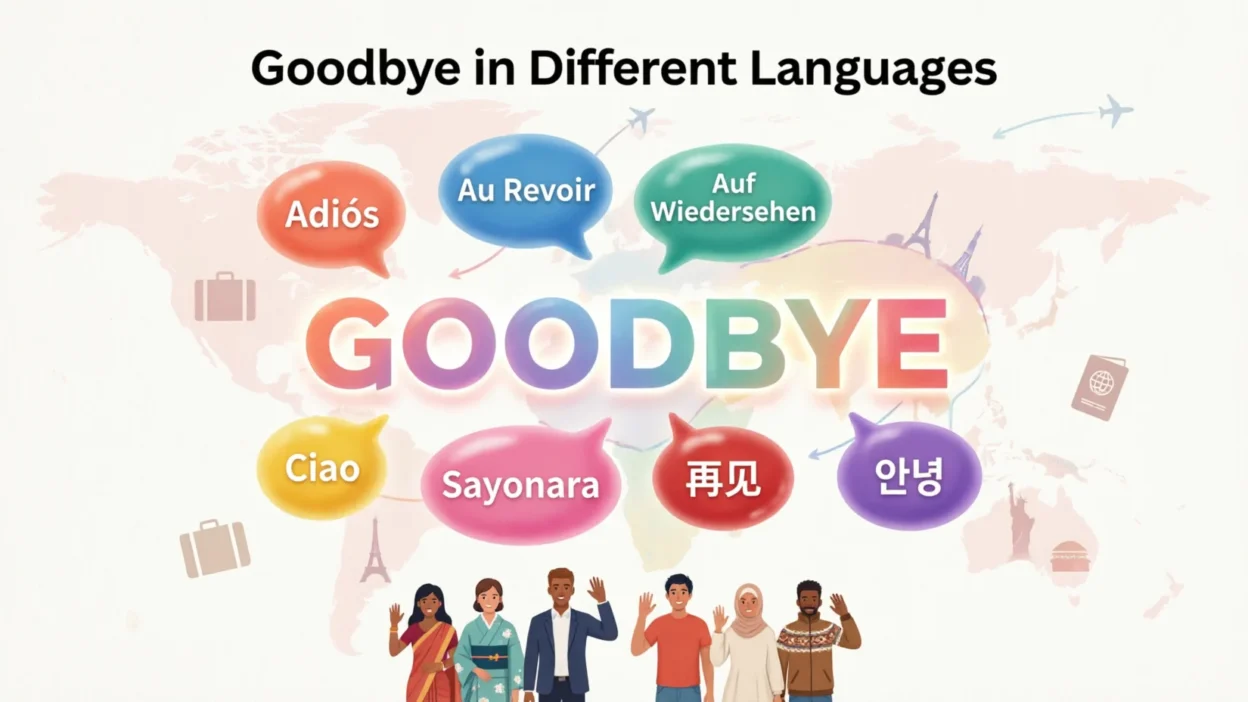
Goodbye in Different Languages
The table below answers the common question, “How do you say goodbye in different languages?” Pronunciations are simplified for English speakers, so they are intended as helpful guides rather than exact phonetic transcriptions.
| Language | Native Phrase | Easy English Pronunciation | Real-Life Example | English Meaning |
|---|---|---|---|---|
| Spanish | Adiós | ah-dee-OHS | ¡Adiós, nos vemos mañana! | Goodbye, see you tomorrow! |
| French | Au revoir | oh ruh-VWAHR | Au revoir, à bientôt ! | Goodbye, see you soon! |
| German | Auf Wiedersehen | owf VEE-der-zay-en | Auf Wiedersehen, bis morgen! | Goodbye, until tomorrow! |
| Italian | Arrivederci | ah-ree-veh-DAIR-chee | Arrivederci, a domani! | Goodbye, see you tomorrow! |
| Portuguese | Adeus | ah-deh-OOSH | Adeus, meu amigo! | Goodbye, my friend! |
| Dutch | Tot ziens | tot zeens | Tot ziens, fijne dag! | Goodbye, have a nice day! |
| Swedish | Hej då | hay doh | Hej då, vi ses snart! | Bye, see you soon! |
| Norwegian | Ha det | hah deh | Ha det, vi ses i morgen! | Bye, see you tomorrow! |
| Danish | Farvel | fah-VEL | Farvel, min ven! | Goodbye, my friend! |
| Finnish | Näkemiin | NAH-keh-meen | Näkemiin, nähdään huomenna! | Goodbye, see you tomorrow! |
| Icelandic | Bless | bles | Bless, sjáumst síðar! | Bye, see you later! |
| Irish | Slán | slawn | Slán, a chara! | Goodbye, friend! |
| Welsh | Hwyl fawr | hoyl vowr | Hwyl fawr, ffrind! | Goodbye, friend! |
| Scottish Gaelic | Mar sin leat | mar shin lyat | Mar sin leat, a charaid! | Goodbye, friend! |
| Polish | Do widzenia | doh vee-DZEN-yah | Do widzenia, do jutra! | Goodbye, see you tomorrow! |
| Czech | Na shledanou | nah SKHLEH-dah-noh | Na shledanou, mějte se hezky! | Goodbye, have a nice day! |
| Slovak | Dovidenia | doh-vee-DEH-nee-ah | Dovidenia, zajtra! | Goodbye, tomorrow! |
| Slovenian | Nasvidenje | nahs-vee-DEN-yeh | Nasvidenje, se vidimo! | Goodbye, see you! |
| Croatian | Doviđenja | doh-vee-JEN-yah | Doviđenja, vidimo se sutra! | Goodbye, see you tomorrow! |
| Serbian | Doviđenja | doh-vee-JEN-yah | Doviđenja, prijatelju! | Goodbye, my friend! |
| Bosnian | Doviđenja | doh-vee-JEN-yah | Doviđenja, vidimo se uskoro! | Goodbye, see you soon! |
| Macedonian | Довидување | doh-vee-DOO-vah-nyeh | Довидување, до утре! | Goodbye, until tomorrow! |
| Bulgarian | Довиждане | doh-veezh-DAH-neh | Довиждане, до скоро! | Goodbye, see you soon! |
| Russian | До свидания | doh svee-DAH-nee-yah | До свидания, до завтра! | Goodbye, until tomorrow! |
| Ukrainian | До побачення | doh poh-BAH-chen-nya | До побачення, до завтра! | Goodbye, until tomorrow! |
| Belarusian | Да пабачэння | dah pah-bah-CHEN-nya | Да пабачэння, да заўтра! | Goodbye, until tomorrow! |
| Lithuanian | Viso gero | VEE-soh GEH-roh | Viso gero, iki rytojaus! | Goodbye, until tomorrow! |
| Latvian | Uz redzēšanos | ooz red-ZAY-shah-nos | Uz redzēšanos, draugs! | Goodbye, friend! |
| Estonian | Head aega | head EYE-gah | Head aega, näeme varsti! | Goodbye, see you soon! |
| Hungarian | Viszontlátásra | VEE-sont-LAH-tash-rah | Viszontlátásra, holnap találkozunk! | Goodbye, see you tomorrow! |
| Romanian | La revedere | lah reh-veh-DEH-reh | La revedere, pe curând! | Goodbye, see you soon! |
| Albanian | Mirupafshim | mee-roo-PAHF-shim | Mirupafshim, shoku im! | Goodbye, my friend! |
| Greek | Αντίο | an-TEE-oh | Αντίο, θα τα πούμε αύριο! | Goodbye, see you tomorrow! |
| Turkish | Hoşça kal | HOSH-cha kahl | Hoşça kal, yarın görüşürüz! | Goodbye, see you tomorrow! |
| Maltese | Ċaw | chow | Ċaw, narak aktar tard! | Bye, see you later! |
| Arabic | مع السلامة | ma’a as-SAH-lah-mah | مع السلامة، أراك غدًا! | Goodbye, see you tomorrow! |
| Hebrew | להתראות | leh-hit-rah-OHT | להתראות, נתראה מחר! | Goodbye, see you tomorrow! |
| Persian | خداحافظ | khod-ah-HA-fez | خداحافظ، فردا میبینمت! | Goodbye, see you tomorrow! |
| Urdu | خدا حافظ | khuda HAA-fiz | خدا حافظ، کل ملتے ہیں! | Goodbye, see you tomorrow! |
| Hindi | अलविदा | ul-vee-DAA | अलविदा, फिर मिलेंगे! | Goodbye, we will meet again! |
| Bengali | বিদায় | bi-DOY | বিদায়, আবার দেখা হবে! | Goodbye, see you again! |
| Punjabi | ਅਲਵਿਦਾ | ul-vee-DAA | ਅਲਵਿਦਾ, ਫਿਰ ਮਿਲਾਂਗੇ! | Goodbye, we will meet again! |
| Gujarati | આવજો | aav-JO | આવજો, ફરી મળીશું! | Goodbye, see you again! |
| Marathi | निरोप | nee-ROHP | निरोप, पुन्हा भेटू! | Goodbye, see you again! |
| Nepali | बिदाइ | bee-DAI | बिदाइ, फेरि भेटौँला! | Goodbye, we will meet again! |
| Sinhala | ආයුබෝවන් | aa-yoo-boh-WAN | ආයුබෝවන්, නැවත හමුවෙමු! | Goodbye, let us meet again! |
| Tamil | விடைபெறுகிறேன் | vee-dye-peh-ruh-GHEH-ren | விடைபெறுகிறேன், மீண்டும் சந்திப்போம்! | Goodbye, we will meet again! |
| Telugu | వీడ్కోలు | VEED-koh-loo | వీడ్కోలు, మళ్లీ కలుద్దాం! | Goodbye, let us meet again! |
| Kannada | ವಿದಾಯ | vee-DAH-yah | ವಿದಾಯ, ಮತ್ತೆ ಭೇಟಿಯಾಗೋಣ! | Goodbye, let us meet again! |
| Malayalam | വിട | vee-DAH | വിട, വീണ്ടും കാണാം! | Goodbye, see you again! |
| Chinese (Mandarin) | 再见 | dzai JYEN | 再见,我们明天见! | Goodbye, see you tomorrow! |
| Cantonese | 再見 | joy-GIN | 再見,聽日見! | Goodbye, see you tomorrow! |
| Japanese | さようなら | sah-yoh-nah-rah | さようなら、また明日! | Goodbye, see you tomorrow! |
| Korean | 안녕히 가세요 | an-nyong-hee gah-SEH-yo | 안녕히 가세요, 내일 봐요! | Goodbye, see you tomorrow! |
| Vietnamese | Tạm biệt | tahm bee-ET | Tạm biệt, hẹn gặp lại! | Goodbye, see you again! |
| Thai | ลาก่อน | lah-gorn | ลาก่อน แล้วพบกันใหม่! | Goodbye, see you again! |
| Indonesian | Selamat tinggal | seh-LAH-maht TING-gahl | Selamat tinggal, sampai jumpa! | Goodbye, see you again! |
| Malay | Selamat tinggal | seh-LAH-maht TING-gahl | Selamat tinggal, jumpa lagi! | Goodbye, see you again! |
| Filipino | Paalam | pah-AH-lahm | Paalam, magkita tayo ulit! | Goodbye, let us meet again! |
| Khmer | លាហើយ | lee-HAEY | លាហើយ ជួបគ្នាពេលក្រោយ! | Goodbye, see you later! |
| Lao | ລາກ່ອນ | lah gawn | ລາກ່ອນ, ແລ້ວພົບກັນໃໝ່! | Goodbye, see you again! |
| Burmese | နှုတ်ဆက်ပါတယ် | hnoke-set par-TAL | နှုတ်ဆက်ပါတယ်၊ နောက်မှတွေ့မယ်! | Goodbye, see you later! |
| Mongolian | Баяртай | bah-YART-eye | Баяртай, маргааш уулзъя! | Goodbye, see you tomorrow! |
| Georgian | ნახვამდის | nah-KHVAM-dees | ნახვამდის, ხვალ შევხვდებით! | Goodbye, see you tomorrow! |
| Armenian | Ցտեսություն | tseh-teh-soo-TYUN | Ցտեսություն, վաղը կհանդիպենք! | Goodbye, see you tomorrow! |
| Azerbaijani | Sağ ol | sah ol | Sağ ol, sabah görüşərik! | Goodbye, see you tomorrow! |
| Kazakh | Сау бол | sow bol | Сау бол, ертең кездесеміз! | Goodbye, see you tomorrow! |
| Uzbek | Xayr | khair | Xayr, ertaga ko‘rishamiz! | Goodbye, see you tomorrow! |
| Swahili | Kwaheri | kwah-HEH-ree | Kwaheri, tutaonana kesho! | Goodbye, see you tomorrow! |
| Amharic | ደህና ሁን | deh-NAH hoon | ደህና ሁን፣ ነገ እንገናኛለን! | Goodbye, see you tomorrow! |
| Zulu | Hamba kahle | HAM-bah KAH-leh | Hamba kahle, sizobonana kusasa! | Go well, see you tomorrow! |
| Xhosa | Hamba kakuhle | HAM-bah kah-KOOH-leh | Hamba kakuhle, siza kubonana! | Go well, we will see each other! |
| Afrikaans | Totsiens | tot-SEENS | Totsiens, sien jou môre! | Goodbye, see you tomorrow! |
| Malagasy | Veloma | veh-LOH-mah | Veloma, mandra-pihaona indray! | Goodbye, see you again! |
| Hawaiian | Aloha | ah-LOH-hah | Aloha, a hui hou! | Goodbye, until we meet again! |
How to Say Goodbye in Different Languages
The most useful way to learn goodbye in different languages is to remember that not every language uses one universal farewell. Some expressions are formal, while others are casual and are more similar to “bye” or “see you.”
For example, Spanish uses “adiós,” while French commonly uses “au revoir.” In Mandarin Chinese, “再见” (zàijiàn) is a familiar everyday farewell. Japanese has several options depending on the situation, including “さようなら” (sayōnara).
When speaking with native speakers, context matters as much as vocabulary. A phrase that works well with a close friend may not be the best choice in a formal conversation.
Formal and Casual Goodbye Expressions
Many languages have different expressions depending on who you are speaking to.
In English, “goodbye” can sound more formal than “bye.” Other languages make similar distinctions. A polite farewell may be preferred when speaking with a teacher, customer, colleague, older person, or someone you have just met.
Casual expressions are often shorter. They may mean “bye,” “see you,” or “take care” rather than a literal translation of “goodbye.”
Understanding this difference can help you use goodbye translations more naturally instead of simply memorizing individual words.
Goodbye Around the World
The idea of saying goodbye exists in virtually every culture, but the expression can carry different meanings.
Some phrases focus on leaving, while others emphasize meeting again. Expressions such as “see you tomorrow,” “until we meet again,” or “go well” show that a farewell does not always have to mean a permanent separation.
This makes learning goodbye in all languages especially interesting. A simple farewell can reveal something about how people communicate warmth, respect, friendship, and future meetings.
Why Learn Goodbye in Different Languages?
Learning how to say goodbye in another language is useful for several reasons.
First, it is an easy vocabulary word to remember because you can use it immediately in everyday conversations. Second, using a person’s language can make interactions feel more friendly and respectful.
Travelers can use these expressions when leaving hotels, restaurants, shops, workplaces, or new friends. Language learners can also practice them as part of basic conversation skills.
Even learning one farewell from a new language can be a small but meaningful way to connect with another culture.
Tips for Pronouncing Goodbye in Other Languages
Pronunciation can vary considerably between languages. The English pronunciation guides in this article are designed to make the phrases easier for beginners.
Start slowly and listen carefully to each syllable. Do not worry about sounding perfect at first. Pay attention to vowel sounds, stress, and the rhythm of the original language.
If you are learning a language seriously, gradually move from an English-style pronunciation toward the native pronunciation.
Goodbye Translations for Travel and Everyday Conversation
Knowing a few farewell expressions can make travel more enjoyable. You can use a local goodbye when leaving a café, saying farewell to a host, finishing a conversation, or parting from someone you met during a trip.
For language learners, these phrases are also useful conversation starters. Once you know how to say hello and goodbye, you already have two practical building blocks for everyday communication.
The 70 expressions above provide a broad selection of goodbye translations from Europe, Asia, Africa, the Middle East, and other parts of the world.
Conclusion
Learning goodbye in different languages is a simple way to expand your vocabulary while discovering how cultures communicate farewell. From “Adiós” in Spanish and “Au revoir” in French to “再见” in Mandarin and “Kwaheri” in Swahili, each expression offers a glimpse into another language and culture.
If you are traveling, studying languages, communicating with international friends, or simply exploring words from around the world, these 70 farewell expressions give you practical vocabulary to use. Remember that pronunciation and context are important, so practice each phrase naturally and respectfully.
FAQs:
1. What is goodbye in different languages?
“Goodbye” has many translations around the world, including “Adiós” in Spanish, “Au revoir” in French, “Auf Wiedersehen” in German, “Arrivederci” in Italian, and “再见” (zàijiàn) in Mandarin Chinese.
2. How do you say goodbye in all languages?
There is no single list containing every language in the world, but goodbye can be expressed in hundreds of languages and dialects. This guide provides 70 widely recognized examples.
3. What is the most common way to say goodbye in different languages?
Many languages have a standard farewell used in everyday conversation. For example, Spanish uses “Adiós,” French uses “Au revoir,” Italian uses “Arrivederci,” and Mandarin Chinese commonly uses “再见.”
4. What is a casual way to say goodbye in other languages?
Casual farewells often correspond to “bye” or “see you.” Examples include “Hej då” in Swedish, “Ċaw” in Maltese, and “Xayr” in Uzbek. The appropriate expression depends on the language and social situation.
5. Why are goodbye translations useful for language learners?
Goodbye translations are useful because farewells are common in everyday conversations. Learning them helps travelers and language learners communicate more naturally and respectfully with people from different cultures.

Evelyn Grace is a language enthusiast and content writer at LingoMean, where she explains the meaning of words, phrases, and expressions. She creates clear, practical, and engaging content that helps readers confidently understand what to say in everyday conversations.