
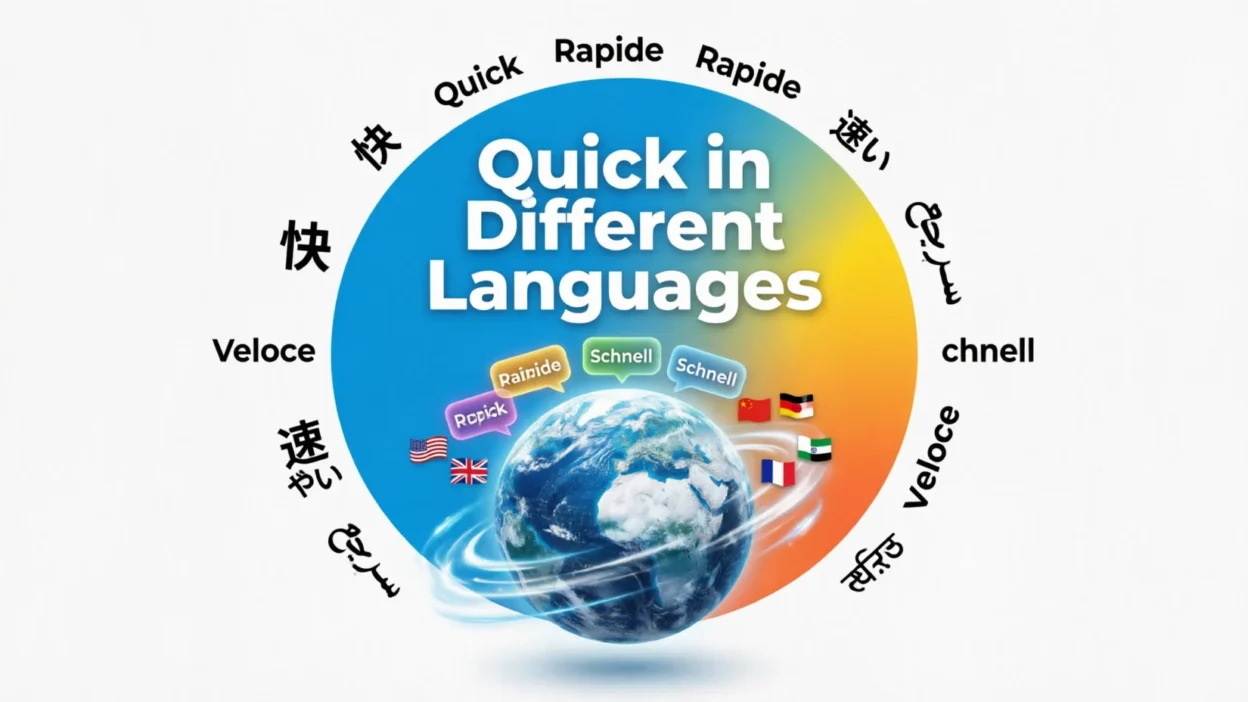
The word “quick” is commonly used to describe something that happens fast, takes little time, or involves rapid movement. If you are learning a new language, traveling, communicating with international friends, or simply exploring vocabulary, knowing how to say quick in different languages can be useful and interesting.
The meaning of “quick” can change slightly depending on context. It may describe a person who moves fast, an action that happens rapidly, or something that takes only a short amount of time.
For example, “Be quick!” is a command to hurry, while “a quick meal” describes something that does not take long to prepare.
In this guide, you will discover quick in all languages through 70 widely spoken and culturally diverse languages. Each translation includes the native word or phrase, an easy English pronunciation, a short real-life example, and its English meaning.
If you have ever wondered how to say quick in different languages, this list provides a simple reference. These quick translations also show how people express speed and urgency around the world.
Quick in Different Languages: 70 Translations
| # | Language | Native Phrase | English Pronunciation | Example Sentence | English Meaning |
|---|---|---|---|---|---|
| 1 | English | Quick | kwik | Be quick! | Hurry! |
| 2 | Spanish | Rápido | RAH-pee-doh | ¡Sé rápido! | Be quick! |
| 3 | French | Rapide | rah-PEED | Sois rapide ! | Be quick! |
| 4 | German | Schnell | shnell | Sei schnell! | Be quick! |
| 5 | Italian | Veloce | veh-LOH-cheh | Sii veloce! | Be quick! |
| 6 | Portuguese | Rápido | RAH-pee-doo | Seja rápido! | Be quick! |
| 7 | Dutch | Snel | snel | Wees snel! | Be quick! |
| 8 | Afrikaans | Vinnig | FIN-ikh | Wees vinnig! | Be quick! |
| 9 | Swedish | Snabb | snab | Var snabb! | Be quick! |
| 10 | Danish | Hurtig | HOOR-tig | Vær hurtig! | Be quick! |
| 11 | Norwegian | Rask | rahsk | Vær rask! | Be quick! |
| 12 | Finnish | Nopea | NOH-peh-ah | Ole nopea! | Be quick! |
| 13 | Icelandic | Fljótur | flyoh-tur | Vertu fljótur! | Be quick! |
| 14 | Irish | Tapa | TOP-uh | Bígí tapa! | Be quick! |
| 15 | Welsh | Cyflym | KUV-lim | Bydd yn gyflym! | Be quick! |
| 16 | Scottish Gaelic | Luath | loo-uh | Bi luath! | Be quick! |
| 17 | Polish | Szybki | SHIB-kee | Bądź szybki! | Be quick! |
| 18 | Czech | Rychlý | RIKH-lee | Buď rychlý! | Be quick! |
| 19 | Slovak | Rýchly | REEKH-lee | Buď rýchly! | Be quick! |
| 20 | Slovenian | Hiter | HEE-ter | Bodi hiter! | Be quick! |
| 21 | Croatian | Brz | brz | Budi brz! | Be quick! |
| 22 | Serbian | Brz | brz | Budi brz! | Be quick! |
| 23 | Bosnian | Brz | brz | Budi brz! | Be quick! |
| 24 | Bulgarian | Бърз | burz | Бъди бърз! | Be quick! |
| 25 | Macedonian | Брз | brz | Биди брз! | Be quick! |
| 26 | Russian | Быстрый | BYS-tree | Будь быстрым! | Be quick! |
| 27 | Ukrainian | Швидкий | SHVYD-kyy | Будь швидким! | Be quick! |
| 28 | Belarusian | Хуткі | KHOO-tkee | Будзь хуткім! | Be quick! |
| 29 | Lithuanian | Greitas | GRAY-tas | Būk greitas! | Be quick! |
| 30 | Latvian | Ātrs | AHTRS | Esi ātrs! | Be quick! |
| 31 | Estonian | Kiire | KEE-reh | Ole kiire! | Be quick! |
| 32 | Hungarian | Gyors | dyorsh | Légy gyors! | Be quick! |
| 33 | Romanian | Rapid | rah-PEED | Fii rapid! | Be quick! |
| 34 | Albanian | I shpejtë | ee SHPAYT | Ji i shpejtë! | Be quick! |
| 35 | Greek | Γρήγορος | GREE-go-ros | Γίνε γρήγορος! | Be quick! |
| 36 | Turkish | Hızlı | huhz-LUH | Hızlı ol! | Be quick! |
| 37 | Maltese | Mgħaġġel | um-AH-jel | Kun mgħaġġel! | Be quick! |
| 38 | Arabic | سريع | saree | كن سريعًا! | Be quick! |
| 39 | Hebrew | מהיר | mah-HEER | היה מהיר! | Be quick! |
| 40 | Persian | سریع | saree | سریع باش! | Be quick! |
| 41 | Urdu | تیز | tez | جلدی کرو! | Hurry up! |
| 42 | Hindi | तेज़ | tez | जल्दी करो! | Hurry up! |
| 43 | Bengali | দ্রুত | DROO-toh | দ্রুত করো! | Be quick! |
| 44 | Punjabi | ਤੇਜ਼ | tez | ਤੇਜ਼ ਕਰੋ! | Be quick! |
| 45 | Gujarati | ઝડપી | JHUP-dee | ઝડપી બનો! | Be quick! |
| 46 | Marathi | जलद | juh-LUD | जलद करा! | Be quick! |
| 47 | Nepali | छिटो | CHHEE-toh | छिटो गर! | Do it quickly! |
| 48 | Sinhala | ඉක්මන් | IK-man | ඉක්මන් වෙන්න! | Be quick! |
| 49 | Tamil | வேகமான | VAY-ga-maa-na | வேகமாக செய்! | Do it quickly! |
| 50 | Telugu | వేగవంతమైన | VAY-ga-van-ta-may-na | త్వరగా చేయి! | Do it quickly! |
| 51 | Kannada | ವೇಗವಾದ | VAY-ga-va-da | ಬೇಗ ಮಾಡು! | Do it quickly! |
| 52 | Malayalam | വേഗത്തിലുള്ള | VAY-ga-thi-loo-lla | വേഗം ചെയ്യൂ! | Do it quickly! |
| 53 | Odia | ଶୀଘ୍ର | SHEE-ghra | ଶୀଘ୍ର କର! | Do it quickly! |
| 54 | Assamese | খৰ | khor | খৰকৈ কৰা! | Do it quickly! |
| 55 | Chinese (Mandarin) | 快 | kuài | 快一点! | A little quicker! |
| 56 | Cantonese | 快 | faai | 快啲! | Be quicker! |
| 57 | Japanese | 速い | hayai | 速くして! | Make it quick! |
| 58 | Korean | 빠른 | ppa-reun | 빨리 해! | Do it quickly! |
| 59 | Vietnamese | Nhanh | nyahn | Nhanh lên! | Hurry up! |
| 60 | Thai | เร็ว | reo | เร็วหน่อย! | A little quicker! |
| 61 | Indonesian | Cepat | CHEH-pat | Cepatlah! | Hurry up! |
| 62 | Malay | Cepat | CHEH-pat | Cepatlah! | Hurry up! |
| 63 | Filipino | Mabilis | ma-BEE-lis | Maging mabilis! | Be quick! |
| 64 | Javanese | Cepet | CHEH-pet | Cepet! | Quick! |
| 65 | Swahili | Haraka | ha-RAH-ka | Fanya haraka! | Hurry up! |
| 66 | Zulu | Shesha | SHEH-sha | Shesha! | Hurry! |
| 67 | Xhosa | Khawuleza | kha-woo-LEH-za | Khawuleza! | Hurry! |
| 68 | Yoruba | Yara | YAH-rah | Yara! | Be quick! |
| 69 | Igbo | Ngwa | ngwah | Ngwa! | Quickly! |
| 70 | Haitian Creole | Vit | veet | Fè vit! | Hurry up! |
What Does “Quick” Mean?
Quick generally means moving, happening, or being completed in a short amount of time. It is closely associated with speed, rapid action, and urgency.
For example:
- Quick response means a response given without much delay.
- Quick runner means someone who runs fast.
- Quick meal means a meal prepared in a short time.
- Quick decision means a decision made rapidly.
- Be quick! means hurry or act faster.
When learning quick in different languages, it is important to remember that some languages use different words depending on whether “quick” describes speed, time, movement, or urgency.
How to Say “Quick” in Different Languages
There are several ways to express the idea of “quick” across languages. Some languages use an adjective equivalent to “fast,” while others commonly use an adverb or command meaning “quickly” or “hurry.”
For example, Spanish uses rápido, French uses rapide, German uses schnell, Italian uses veloce, and Portuguese uses rápido.
In several Asian languages, the most natural everyday expression may be closer to “quickly” or “hurry up” rather than a direct adjective. This is why context matters when using these quick translations in conversation.
Quick in European Languages
European languages offer many interesting similarities. Spanish rápido, Portuguese rápido, French rapide, and Romanian rapid are related in form and meaning.
German uses schnell, Dutch uses snel, Swedish uses snabb, and Norwegian uses rask. Slavic languages also have their own related forms, such as Polish szybki, Russian быстрый, Ukrainian швидкий, and Bulgarian бърз.
These examples make it easier to see how the concept of speed is expressed across Europe.
Quick in Asian Languages
Asian languages often express the idea of “quick” according to the situation.
In Mandarin Chinese, 快 (kuài) is commonly used for “fast” or “quick.” Japanese uses 速い (hayai) for something that is fast, while 速くして (hayaku shite) can be used when asking someone to make something quicker.
Hindi and Urdu commonly use words such as तेज़ (tez) and تیز (tez) for fast or quick. In everyday commands, expressions meaning “quickly” or “hurry up” may sound more natural.
Understanding these differences can help learners avoid translating words too literally.
Quick in Middle Eastern Languages
Arabic uses سريع (saree’) for “quick” or “fast,” while Hebrew uses מהיר (mahir). Persian uses سریع (sari’).
Although these languages use words that can directly correspond to “quick,” the exact form can change according to grammar, gender, number, or sentence structure.
For practical conversation, learning the common everyday command for “hurry up” can also be useful.
Quick in African Languages
The concept of speed is expressed in many different ways across African languages.
Swahili uses haraka, a useful word associated with speed and urgency. Zulu uses shesha, while Xhosa uses khawuleza. Yoruba uses yara, and Igbo uses ngwa.
These examples demonstrate why learning individual words is only one part of language learning. Context and sentence structure are equally important.
Quick Around the World
The word “quick” appears in everyday situations almost everywhere. People use it when asking someone to hurry, describing a fast action, or talking about something that takes little time.
Knowing quick in all languages can be especially useful for travelers, language learners, teachers, writers, and anyone interested in multilingual communication.
The 70 languages above provide a broad look at quick around the world, from European and Asian languages to languages spoken across Africa and other regions.
Tips for Learning “Quick” in Another Language
Learning a translation is easier when you connect it with a real situation.
Try these simple methods:
- Learn the everyday form first. Focus on the word people commonly use in conversation.
- Practice it in a sentence. A complete phrase is easier to remember than an isolated word.
- Listen to pronunciation. Pay attention to native speech whenever possible.
- Learn related words. Words such as “fast,” “slow,” “hurry,” and “quickly” can help build vocabulary.
- Consider context. A direct translation of “quick” may not always be the most natural expression in another language.
FAQs:
1. How do you say “quick” in Spanish?
“Quick” in Spanish is commonly rápido. For example, ¡Sé rápido! means “Be quick!”
2. What is “quick” in French?
“Quick” in French is rapide. The phrase Sois rapide ! can be used to tell someone to be quick.
3. How do you say “quick” in German?
“Quick” in German is schnell. Sei schnell! means “Be quick!”
4. How do you say “quick” in Japanese?
A common Japanese word for “fast” or “quick” is 速い (hayai). Depending on the context, Japanese can also use forms meaning “quickly” or “make it quick.”
5. What is the most common meaning of “quick”?
“Quick” generally means fast, rapid, or taking a short amount of time. The best translation depends on whether you are describing a person, movement, action, or amount of time.
Conclusion
Learning how to say quick in different languages is a simple way to expand your vocabulary and understand how different cultures express speed and urgency. While some languages have a direct equivalent of “quick,” others naturally use words or phrases meaning “quickly,” “fast,” or “hurry up.”
The 70 translations in this guide cover languages from Europe, Asia, the Middle East, Africa, and other parts of the world. By practicing the native phrase together with its pronunciation and a real-life example, you can remember each expression more easily.
If you are studying languages, traveling, communicating with international friends, or exploring quick translations around the world, these examples provide a useful starting point.

Carter Connor is a language enthusiast and content writer at LingoMean, helping readers discover what to say in everyday conversations with clear explanations, practical examples, and easy-to-understand communication tips.