
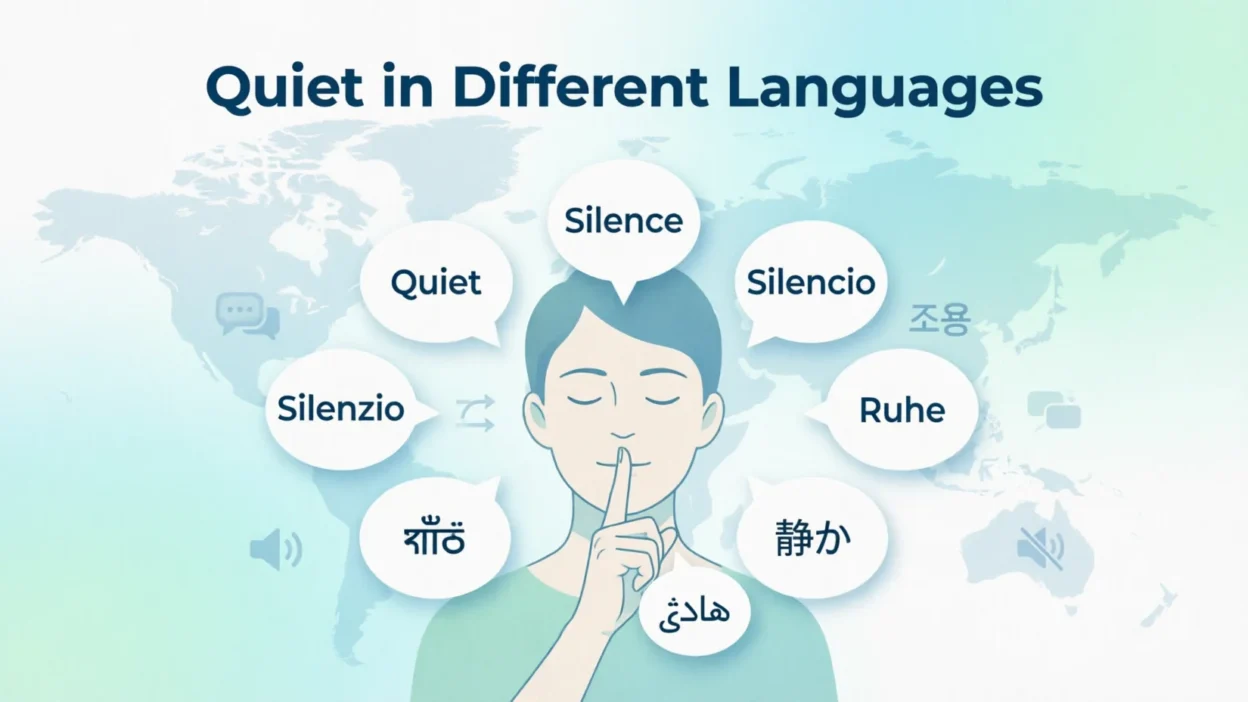
Have you ever wondered how to say quiet in different languages? If you’re traveling, learning a new language, teaching students, or simply curious about world cultures, knowing how to express “quiet” can be incredibly useful.
The word quiet is commonly used in schools, libraries, workplaces, hospitals, and homes. Learning quiet translations helps you communicate politely and understand everyday conversations across different countries.
This guide brings together quiet in all languages in one place, making it easy to compare phrases and pronunciations.
Below, you’ll find a mobile-friendly table featuring 70 languages, including the native translation, easy pronunciation, and practical examples. If you’ve ever searched for how to say quiet in different languages or wanted to explore quiet around the world, this guide has everything you need.
Quiet in Different Languages (70 Languages)
| Language | Native Phrase | English Pronunciation | Example Sentence | English Meaning |
|---|---|---|---|---|
| English | Quiet | Kwy-et | Please stay quiet. | Please remain silent. |
| Spanish | Silencio | See-len-see-oh | Guarda silencio. | Keep quiet. |
| French | Silence | See-lahns | Fais silence. | Be quiet. |
| German | Ruhig | Roo-hig | Sei ruhig. | Be quiet. |
| Italian | Silenzio | See-len-tsee-oh | Fai silenzio. | Be quiet. |
| Portuguese | Silêncio | See-len-see-oh | Faça silêncio. | Keep quiet. |
| Dutch | Stil | Stil | Wees stil. | Be quiet. |
| Danish | Stille | Still-eh | Vær stille. | Be quiet. |
| Swedish | Tyst | Toost | Var tyst. | Be quiet. |
| Norwegian | Stille | Still-eh | Vær stille. | Be quiet. |
| Finnish | Hiljaa | Heel-yah | Ole hiljaa. | Be quiet. |
| Icelandic | Hljótt | Hlyoht | Vertu hljótt. | Be quiet. |
| Irish | Ciúin | Kyoo-in | Bí ciúin. | Be quiet. |
| Welsh | Tawel | Tow-el | Byddwch yn dawel. | Be quiet. |
| Scottish Gaelic | Sàmhach | Saa-vakh | Bi sàmhach. | Be quiet. |
| Polish | Cicho | Tsee-ho | Bądź cicho. | Be quiet. |
| Czech | Ticho | Tee-ho | Buď ticho. | Be quiet. |
| Slovak | Ticho | Tee-ho | Buď ticho. | Be quiet. |
| Slovenian | Tiho | Tee-ho | Bodi tiho. | Be quiet. |
| Croatian | Tiho | Tee-ho | Budi tih. | Be quiet. |
| Serbian | Тихо | Tee-ho | Budi tih. | Be quiet. |
| Bosnian | Tiho | Tee-ho | Budi tih. | Be quiet. |
| Bulgarian | Тихо | Tee-ho | Бъди тих. | Be quiet. |
| Romanian | Liniște | Lee-neesh-teh | Fă liniște. | Keep quiet. |
| Hungarian | Csend | Chend | Légy csendben. | Be quiet. |
| Greek | Ήσυχα | EE-see-ha | Κάνε ησυχία. | Be quiet. |
| Albanian | Qetë | Che-teh | Rri i qetë. | Stay quiet. |
| Russian | Тихо | Tee-ho | Будь тихо. | Be quiet. |
| Ukrainian | Тихо | Tee-ho | Будь тихо. | Be quiet. |
| Belarusian | Ціха | Tsee-ha | Будзь ціха. | Be quiet. |
| Lithuanian | Tyliai | Tee-lyai | Būk tyliai. | Be quiet. |
| Latvian | Klusi | Kloo-see | Esi kluss. | Be quiet. |
| Estonian | Vaikselt | Vyke-selt | Ole vaikselt. | Be quiet. |
| Turkish | Sessiz | Ses-seez | Sessiz ol. | Be quiet. |
| Azerbaijani | Sakit | Sah-kit | Sakit ol. | Be quiet. |
| Kazakh | Тыныш | Tuh-nush | Тыныш бол. | Be quiet. |
| Uzbek | Jim | Jeem | Jim bo’l. | Be quiet. |
| Turkmen | Ümsüm | Um-soom | Ümsüm bol. | Be quiet. |
| Arabic | هادئ | Hah-dee | كن هادئًا. | Be quiet. |
| Hebrew | שקט | Sheh-ket | תהיה בשקט. | Be quiet. |
| Persian | ساکت | Sah-ket | ساکت باش. | Be quiet. |
| Urdu | خاموش | Kha-mosh | خاموش رہیں۔ | Stay quiet. |
| Hindi | शांत | Shaant | शांत रहो। | Stay quiet. |
| Punjabi | ਚੁੱਪ | Chupp | ਚੁੱਪ ਰਹੋ। | Stay quiet. |
| Bengali | শান্ত | Shanto | শান্ত থাকো। | Stay quiet. |
| Gujarati | શાંત | Shaant | શાંત રહો. | Stay quiet. |
| Marathi | शांत | Shaant | शांत रहा. | Stay quiet. |
| Nepali | शान्त | Shaant | शान्त बस। | Stay quiet. |
| Sinhala | නිහඬ | Nihanda | නිහඬ ඉන්න. | Stay quiet. |
| Tamil | அமைதி | Amaithi | அமைதியாக இரு. | Stay quiet. |
| Telugu | నిశ్శబ్దం | Nish-shabdam | నిశ్శబ్దంగా ఉండు. | Stay quiet. |
| Kannada | ಶಾಂತ | Shaanta | ಶಾಂತವಾಗಿರು. | Stay quiet. |
| Malayalam | ശാന്തം | Shaantham | ശാന്തമായി ഇരിക്കുക. | Stay quiet. |
| Thai | เงียบ | Ngiap | เงียบหน่อย | Be quiet please. |
| Vietnamese | Im lặng | Eem lang | Hãy im lặng. | Please be quiet. |
| Indonesian | Diam | Dee-am | Tolong diam. | Please be quiet. |
| Malay | Diam | Dee-am | Tolong diam. | Please be quiet. |
| Filipino | Tahimik | Ta-hi-meek | Manahimik ka. | Be quiet. |
| Chinese (Mandarin) | 安静 | An-jing | 请安静。 | Please be quiet. |
| Cantonese | 安靜 | On-jing | 請安靜。 | Please be quiet. |
| Japanese | 静か | Shee-zoo-ka | 静かにしてください。 | Please be quiet. |
| Korean | 조용히 | Jo-yong-hee | 조용히 하세요. | Please be quiet. |
| Mongolian | Чимээгүй | Chi-meg-gui | Чимээгүй бай. | Be quiet. |
| Khmer | ស្ងាត់ | Sngat | សូមស្ងាត់។ | Please be quiet. |
| Lao | ມິດ | Mit | ກະລຸນາມິດ. | Please be quiet. |
| Burmese | တိတ်ဆိတ် | Tate-sate | တိတ်ဆိတ်နေပါ။ | Stay quiet. |
| Swahili | Kimya | Keem-ya | Kaa kimya. | Stay quiet. |
| Zulu | Thula | Too-la | Thula. | Be quiet. |
| Afrikaans | Stil | Stil | Bly stil. | Stay quiet. |
| Yoruba | Dakẹ | Dah-keh | Dakẹ jọwọ. | Please be quiet. |
| Hausa | Yi shiru | Yee shee-roo | Yi shiru. | Keep quiet. |
| Somali | Aamus | Aa-moos | Aamus. | Be quiet. |
Why Learn “Quiet” in Different Languages?
Learning the word quiet in different languages is useful for everyday communication. It is one of the most common words used in classrooms, libraries, museums, hospitals, meetings, and public transportation.
Knowing these translations can help you:
- Communicate respectfully while traveling.
- Improve your foreign language vocabulary.
- Understand common signs and announcements.
- Teach multilingual students.
- Compare words across different cultures.
How to Say Quiet in Different Languages Correctly
Although many languages translate “quiet” directly, pronunciation and usage can vary. Some languages use a word that means “silent,” while others use phrases like “stay quiet” or “keep quiet.
For the best pronunciation:
- Listen to native speakers whenever possible.
- Practice short example sentences.
- Learn the context where each phrase is commonly used.
- Repeat the words aloud several times.
Common Places Where You May Need to Say “Quiet”
The word “quiet” is useful in many daily situations, including:
- Schools and classrooms
- Libraries
- Hospitals
- Movie theaters
- Museums
- Offices
- Religious places
- Public transportation
- Meetings
- Study rooms
Quiet Around the World
Every culture values peaceful environments, although expressions differ slightly. Some countries prefer polite requests such as “Please be quiet,” while others simply use a single word meaning “Silence.”
Understanding quiet around the world helps travelers communicate politely and shows respect for local customs.
Conclusion
Learning quiet in different languages is an easy way to improve your communication skills and broaden your cultural understanding.
If you’re traveling, studying, teaching, or simply expanding your vocabulary, these 70 translations provide a practical reference for everyday situations. Keep this guide handy whenever you need to say “quiet” confidently in another language.
FAQs:
1. How do you say quiet in different languages?
The word “quiet” has different translations depending on the language. For example, it is Silencio in Spanish, Silence in French, 静か in Japanese, and خاموش in Urdu.
2. Why should I learn quiet in different languages?
Learning these translations helps when traveling, studying languages, communicating internationally, and understanding signs or announcements.
3. Is the word “quiet” the same as “silence” in every language?
No. Some languages use one word for both meanings, while others have separate words for “quiet,” “silent,” and “be quiet.
4. Which languages use a word similar to “silence”?
Romance languages such as Spanish, French, Italian, and Portuguese use words closely related to the Latin root for “silence.”
5. Where is the word “quiet” commonly used?
It is commonly used in schools, libraries, hospitals, workplaces, public transport, museums, and other places where silence is expected.

Anthony Dylan is a language enthusiast and content writer at LingoMean, where he helps readers understand what to say in different situations. He creates clear, practical, and engaging guides that improve communication, confidence, and everyday conversations.